About 589 minutes
The West Riding Territorials in the Great War — Reading Companion
World Events
135,309 recorded words. 5 minutes difference from this book's estimate.
View Gutenberg source #69691
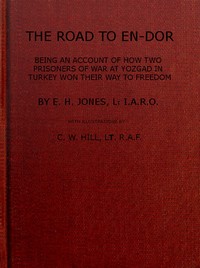
For The Road to En-Dor Being an Account of How Two Prisoners of War at Yozgad in Turkey Won Their Way to Freedom — Inside the Classic, the stored edition analysis reports 136,480 words, 9 hr 54 min estimated reading time, and 36 detected text sections.
The text analysis averages about 15.4 words per sentence, while the detected sections provide another way to judge how the source is divided.
Project Gutenberg metadata also associates the work with “Spiritualism,” connecting these edition facts with the source record’s subject description.
Explore this collection
These alternatives are selected using recorded categories and estimated reading time.
About 589 minutes
World Events
135,309 recorded words. 5 minutes difference from this book's estimate.
View Gutenberg source #69691About 580 minutes
World Events
133,378 recorded words. 14 minutes difference from this book's estimate.
View Gutenberg source #71091About 562 minutes
World Events
129,054 recorded words. 32 minutes difference from this book's estimate.
View Gutenberg source #76843Search stored excerpts and compare books → Choose by your preferences →
Choices use stored catalog measurements. Estimates vary with reading speed. A shared category is a catalog label, not a claim that two books have the same argument or literary quality.
Search reads excerpt text stored with this catalog and links to its associated Gutenberg record. The connection is stored in the site database; this tool does not recheck that every excerpt is word-for-word identical to that external record. Excerpt search does not cover every chapter and does not verify historical publication dates.
Catalog snapshot checked: 2026-09-25. Coverage: 97 public books, 97 available source excerpts.
Read the complete public-domain text at its original source.
Read on Project GutenbergThe Road to En-Dor opens with a preface quoting T.H. Huxley’s dismissal of spiritualism, then immediately counters it: Huxley was never a prisoner of war in Turkey. This sets the tone for a narrative where the authors weaponize belief in the supernatural. The book is a collaborative memoir by Lieutenant E.H. Jones and Lieutenant C.W. Hill, illustrated by Hill’s photographs. The title references the biblical Witch of Endor, and a Kipling epigram underscores the road’s ancient, perilous allure. The account is grounded in specific, often absurd, details: the commandant is called “the Pimple,” a cook tries to kiss Jones, and a treasure hunt is staged on April Fools’ Day. The authors present themselves as improvisers, turning captivity into a stage.
The authors do not claim genuine spiritualist powers. Instead, they describe how they manufactured séances to gain privileges and sow confusion. The preface explicitly states that spiritualism allowed them to “kill much empty and weary time” and obtain comforts. In one episode, the “Spook” instructs the commandant to double sentries and prohibit roll-call, securing the authors a quiet evening to develop photographs. The séance is a performance: Hill hides in a cupboard to develop film while Jones paces in an “agony of impatience.” The narrative emphasizes the mechanics of deception—timing, props, and nerve—rather than mystical experience.
Hill’s role as photographer is central. The authors need photographic proof to blackmail the commandant, and the climax of one episode is Hill emerging from a cupboard with a roll of “newly-developed V.P. Kodak films.” Jones notes that the negatives are “over-exposed” but show “Bimbashi Kiazim Bey, Commandant of Yozgad” clearly. The camera is a weapon: held steady for time exposures under tense conditions, it captures the Turks’ complicity. The narrative treats photography as both a practical tool and a source of dark humor—Hill is “never wholly satisfied with his own performances.” The images are not reproduced in the text, but their existence drives the plot.
The book is dense with specific, often sardonic, references. The camp at Yozgad is a real location; the authors name fellow prisoners like Lieut. Taylor, R.E., who shouts “Sivas” as a false lead. The commandant is consistently called “the Pimple,” and a cook’s attempt to kiss Jones is met with Hill choking and turning his back. The treasure hunt is set in “Bones’s Nullah,” a gully beyond the Pinewoods. These details ground the narrative in a particular time and place, while the authors’ tone remains wry. They describe a “dreadful explosion” and OOO’s murder plot with the same matter-of-factness as they describe developing film.
Readers should approach The Road to En-Dor as a crafted narrative, not a transparent diary. Jones and Hill are self-aware storytellers who shape their material for effect. The book rewards attention to its layered ironies: the authors exploit belief they do not share, and their escape depends on the very superstition they mock. The photographs, though absent from this edition, are integral to the plot. This is a memoir of ingenuity under duress, told with a dry, collaborative voice that never loses sight of the absurdity of its own premise.
I often think of that other volume, The Road to En-Dor, where two prisoners spin a ghostly fiction to win their freedom. It shares a quiet kinship with The Scout and Ranger Being the Personal Adventures of Corporal Pike of the Fourth Ohio cavalry — A Reader’s Guide, both men simply improvising with wits against hard walls, each step a small, stubborn invention.
Capture what you thought, learned, and would like to remember.