About 557 minutes
The Scout and Ranger Being the Personal Adventures of Corporal Pike of the Fourth Ohio cavalry — A Reader’s Guide
World Events
127,902 recorded words. 5 minutes difference from this book's estimate.
View Gutenberg source #41995
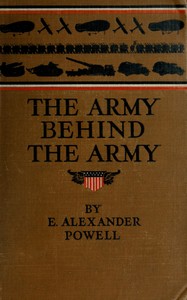
For The army behind the army — Key Ideas to Explore, the stored edition analysis reports 129,054 words, 9 hr 22 min estimated reading time, and 23 detected text sections.
The text analysis averages about 31.1 words per sentence, while the detected sections provide another way to judge how the source is divided.
Project Gutenberg metadata also associates the work with “World War, 1914-1918 -- United States,” connecting these edition facts with the source record’s subject description.
Explore this collection
These alternatives are selected using recorded categories and estimated reading time.
About 557 minutes
World Events
127,902 recorded words. 5 minutes difference from this book's estimate.
View Gutenberg source #41995About 580 minutes
World Events
133,378 recorded words. 18 minutes difference from this book's estimate.
View Gutenberg source #71091About 589 minutes
World Events
135,309 recorded words. 27 minutes difference from this book's estimate.
View Gutenberg source #69691Search stored excerpts and compare books → Choose by your preferences →
Choices use stored catalog measurements. Estimates vary with reading speed. A shared category is a catalog label, not a claim that two books have the same argument or literary quality.
Search reads excerpt text stored with this catalog and links to its associated Gutenberg record. The connection is stored in the site database; this tool does not recheck that every excerpt is word-for-word identical to that external record. Excerpt search does not cover every chapter and does not verify historical publication dates.
Catalog snapshot checked: 2026-09-25. Coverage: 97 public books, 97 available source excerpts.
Read the complete public-domain text at its original source.
Read on Project GutenbergMajor E. Alexander Powell, a U.S. Army officer and former war correspondent, wrote The Army Behind the Army in 1919 as an insider’s look at the American Expeditionary Forces’ support structure. The book opens with an acknowledgment listing numerous military officials who reviewed each chapter for accuracy, signaling Powell’s reliance on official cooperation. His narrative voice is that of a knowledgeable observer who balances technical detail with anecdotal color, as when he recounts a soldier’s remark about a shell’s range: “Ah could staht runnin’ at brekfus’-time an’ that theah shell ’ud git me jes’ when Ah got home foah suppah.” This blend of factual reporting and vernacular dialogue characterizes Powell’s approach throughout.
Powell devotes considerable attention to the Ordnance Department’s engineering feats, describing the production of a 16-inch howitzer weighing nearly a million pounds and mounted on a railway car. He explains that each such cannon had its own train of ammunition, tools, and crew cars, emphasizing mobility despite immense size. The author highlights the work of Major Forest Ray Moulton, an astronomer turned ballistician, who redesigned a copper driving-band on a 6-inch shell to increase its range by two and a half miles without altering the gun or powder charge. Powell notes that Moulton also reduced shell dispersion to one-eighth the previous area, a claim he presents as remarkable but does not verify beyond the official revision process. The chapter on machine-guns addresses public criticism of the Ordnance Department’s rejection of the Lewis gun in favor of the Browning. Powell admits that some attacks were justified, but he argues that the Lewis gun’s weight made it unsuitable as a replacement for either the Browning machine-rifle or machine-gun. This section shows Powell’s willingness to engage with controversy while defending his sources.
The Corps of Engineers and Quartermaster Corps receive detailed treatment, though the excerpts provide only glimpses. Powell’s method is to describe specific projects, such as the commandeering of guns manufactured for Chile and the mounting of 14-inch naval guns on railway carriages. He emphasizes the scale of American industrial mobilization, noting that entirely new factories had to be built for specialized equipment. The narrative pace shifts between broad overviews and tight focus on individual achievements, like the design of recoil mechanisms for heavy artillery. Powell’s language remains concrete, avoiding abstract praise; he writes of “the design and production of a device which would absorb its recoil of seven million pounds” as an engineering problem, not a triumph. This section likely includes descriptions of port construction, railroad building, and supply depots, though the excerpts do not reveal the full scope. The author’s reliance on official sources gives the text an authoritative tone, but his occasional asides—such as the soldier’s dialect quote—prevent it from becoming purely technical.
Powell’s narrative voice is that of a participant-observer who moves between firsthand testimony and summarized reports. He uses the first person sparingly, as when he states, “I am thoroughly familiar with the details of the long and bitter controversy” over machine-guns, but he does not insert personal opinion into technical descriptions. The prose is brisk and declarative, with sentences that often begin with concrete subjects: “The most ambitious project undertaken by Ordnance…” or “Each of these monster railway-cannon has its own train.” Powell occasionally includes dialogue in vernacular, as with the unnamed soldiers’ exchange about shell range, which injects humor and humanizes the subject. The pace varies: detailed engineering passages are dense with numbers and specifications, while anecdotes provide relief. The acknowledgment page reveals that each chapter was reviewed by the relevant branch chief, suggesting a collaborative vetting process that shapes the book’s reliability. Powell does not claim to have witnessed every event; he attributes information to officers and official reports, maintaining a journalistic distance.
Readers should approach The Army Behind the Army as a contemporary document shaped by its author’s dual role as officer and writer. Powell’s access to high-level sources gives the book unusual authority, but his perspective is that of an advocate for the War Department’s efforts. The text rewards those interested in the practical details of World War I logistics, though it offers little critical analysis of the broader strategy. For a fuller picture, compare Powell’s accounts with other memoirs or official histories from the period.
Powell’s account of the men behind the guns stayed with me—not the battles, but the quiet machinery of supply, the patience in the depots. It felt like watching someone’s hands at steady work. That same intimacy lives in The Tale of a Trooper — Inside the Classic, which left me thinking about the small, unglamorous moments that make up a soldier’s story. I keep turning it over.
Create a short personal record of your experience with this book.