About 76 minutes
Their Crimes — Reading Companion
World Events
17,431 recorded words. 4 minutes difference from this book's estimate.
View Gutenberg source #10225
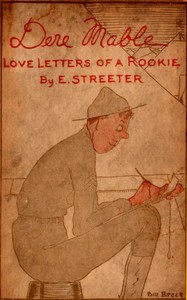
The catalog record for Dere Mable: Love Letters of a Rookie — Text and Context provides practical reading context through 16,452 words, 1 hr 12 min estimated reading time, and 3 detected text sections.
The text analysis averages about 13.3 words per sentence, while the detected sections provide another way to judge how the source is divided.
Project Gutenberg metadata also associates the work with “World War, 1914-1918 -- Humor, caricatures, etc.,” connecting these edition facts with the source record’s subject description.
Explore this collection
These alternatives are selected using recorded categories and estimated reading time.
About 76 minutes
World Events
17,431 recorded words. 4 minutes difference from this book's estimate.
View Gutenberg source #10225About 85 minutes
World Events
19,442 recorded words. 13 minutes difference from this book's estimate.
View Gutenberg source #27193About 87 minutes
World Events
19,896 recorded words. 15 minutes difference from this book's estimate.
View Gutenberg source #75081Search stored excerpts and compare books → Choose by your preferences →
Choices use stored catalog measurements. Estimates vary with reading speed. A shared category is a catalog label, not a claim that two books have the same argument or literary quality.
Search reads excerpt text stored with this catalog and links to its associated Gutenberg record. The connection is stored in the site database; this tool does not recheck that every excerpt is word-for-word identical to that external record. Excerpt search does not cover every chapter and does not verify historical publication dates.
Catalog snapshot checked: 2026-09-25. Coverage: 97 public books, 97 available source excerpts.
Read the complete public-domain text at its original source.
Read on Project GutenbergEdward Streeter’s Dere Mable: Love Letters of a Rookie presents itself as a series of letters from a newly enlisted soldier, “Bill,” to his sweetheart Mable. The text is written entirely in a phonetic, misspelled vernacular that mimics the voice of an uneducated recruit. The catalog subject “World War, 1914-1918 – Humor, caricatures, etc.” accurately captures the book’s comic intent, but the excerpts reveal a more complicated tone. While much of the humor derives from Bill’s malapropisms and complaints about camp life—he describes the camp as “a good place for a Rocky Mountin goat if he didnt break his neck”—the letters also include a graphic war poem that Bill himself admits made him “come pretty near being” sick. This tension between lighthearted grumbling and grim imagery is the book’s most distinctive feature.
The letters are written in a deliberately uneducated dialect, with consistent misspellings (“rite” for write, “minit” for minute, “jelusy” for jealousy) and grammatical errors. This voice is not merely decorative; it shapes the reader’s perception of the narrator as naive, earnest, and often comically literal-minded. For instance, Bill explains that “The Rine is a German river where they make wine near Berlin,” revealing both his limited knowledge and his attempt to sound informed. The dedication addresses “a million Private Bills who have suddenly learnt to call a coat a blouse,” framing the book as a representative portrait of the common soldier. However, the excerpts do not confirm whether this voice is sustained throughout or whether it evolves. The consistency of the dialect suggests a deliberate stylistic choice rather than a lapse in editing.
Much of the humor in the excerpts comes from Bill’s misunderstandings of military life. He complains about being made a “food speshulist” (kitchen duty) and recounts the captain’s analogy that a company is “built up somethin like a man,” with Bill being “pretty well fitted for my part by nature”—a backhanded compliment that Bill takes at face value. The illustrations, listed in the front matter, reinforce this comic tone with titles like “You walk a post but there aint no post” and “I dont like any sargeant.” Yet the book also includes Bill’s war poem, which describes “sticky pools of gory blood” and “bits of Huns go flyin round.” The poem is presented as a serious attempt at realism, and Bill notes that it “depres them awful.” This juxtaposition suggests that the book’s humor is not purely escapist; it acknowledges the violence of war even as it mocks the soldier’s attempts to articulate it.
The front matter lists thirty-five illustrations by G. William Breck, each with a caption drawn from the text. These captions, such as “I just found it in my bakin can” and “I wear them every night over my uniform,” hint at visual gags that complement the letters. The illustrations are not reproduced in the excerpts, but their presence suggests that the book was designed as a collaborative work, with images providing additional comic commentary. The captions often highlight physical humor or absurd situations, like “Somebodied set a trunk on the turky.” The dedication’s mention of “a million Private Bills” implies that the illustrations aim to depict a generic everyman soldier, but without seeing the images, it is impossible to assess how they interact with the text or whether they soften or amplify the poem’s grimness.
Readers should approach Dere Mable as a period artifact that uses humor to navigate the gap between civilian expectations and military reality. The letters’ misspellings and malapropisms are not errors but a crafted persona. Pay attention to how the comic voice handles moments of genuine unease, such as the war poem or Bill’s jealousy over “Broggins.” The illustrations, though absent from this text, are integral to the original publication; imagining their content may enrich the reading experience.
That rainy afternoon, Dere Mable’s letters made the mud and loneliness of training camps feel absurdly human. I kept wondering what maps that rookie never saw. Later, almost by accident, I found The war against Germany: Europe and adjacent areas — A Reader’s Guide, and the whole landscape quietly filled in behind his misspelled words.
Capture what you thought, learned, and would like to remember.