About 187 minutes
History of the World War, Volume 2 (of 7) — Key Ideas to Explore
World Events
43,006 recorded words. 1 minutes difference from this book's estimate.
View Gutenberg source #74727
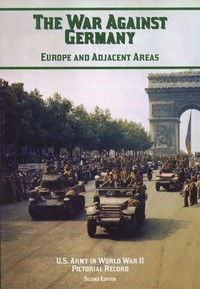
For The war against Germany: Europe and adjacent areas — A Reader’s Guide, the stored edition analysis reports 42,554 words, 3 hr 6 min estimated reading time, and 397 detected text sections.
The text analysis averages about 17.3 words per sentence, while the detected sections provide another way to judge how the source is divided.
Project Gutenberg metadata also associates the work with “World War, 1939-1945 -- Campaigns -- Western Front,” connecting these edition facts with the source record’s subject description.
Explore this collection
These alternatives are selected using recorded categories and estimated reading time.
About 187 minutes
World Events
43,006 recorded words. 1 minutes difference from this book's estimate.
View Gutenberg source #74727About 182 minutes
World Events
41,689 recorded words. 4 minutes difference from this book's estimate.
View Gutenberg source #72085About 196 minutes
World Events
44,942 recorded words. 10 minutes difference from this book's estimate.
View Gutenberg source #20655Search stored excerpts and compare books → Choose by your preferences →
Choices use stored catalog measurements. Estimates vary with reading speed. A shared category is a catalog label, not a claim that two books have the same argument or literary quality.
Search reads excerpt text stored with this catalog and links to its associated Gutenberg record. The connection is stored in the site database; this tool does not recheck that every excerpt is word-for-word identical to that external record. Excerpt search does not cover every chapter and does not verify historical publication dates.
Catalog snapshot checked: 2026-09-25. Coverage: 97 public books, 97 available source excerpts.
Read the complete public-domain text at its original source.
Read on Project GutenbergThis volume presents a curated selection of U.S. Army photographs from the European theater, each paired with a caption that specifies location, date, unit, and tactical context. The images range from aerial views of bombed cities to close-ups of soldiers firing captured German 88-mm. guns. The captions do not merely describe what is visible; they anchor each photograph in the operational narrative—noting, for example, that Aachen fell on 21 October 1944 after house-to-house fighting, or that the Third Army was stalled near Metz for two months. The result is a record that balances the immediacy of the visual with the precision of the military historian.
The captions repeatedly foreground terrain as a determinant of action. The West Wall, or “Siegfried Line,” is described not as a symbolic barrier but as a set of fortifications that troops fought through “six miles” of over two weeks. A bridgehead across the Moselle south of Metz is identified by the village of Arnaville. The photographs themselves—of rubble-choked streets, open fields, and river crossings—are chosen to show “important terrain features,” as the foreword states. The reader is invited to see how geography shaped the capabilities and limitations of weapons on both sides.
Alongside combat images, the volume includes photographs of water points, bakeries, and supply lines. One caption notes that engineers were responsible for “the purification of drinking water” and set up points from which all units drew daily supply. Another shows bread cooling on racks in a Quartermaster bakery. These details underscore that the army moved not only on fuel and ammunition but on bread and clean water. The juxtaposition of a five-gallon water can being filled and a machine gun being fired in Aachen makes the logistical backbone of the offensive visible.
The captions mark time as precisely as they mark place. The period from 25 September to 7 November 1944 is called “the most unproductive phase” of the Third Army’s operations. The First Army, after taking Aachen, began “preparations for a drive to the Rhine as soon as supplies and reinforcements should become available.” The photographs freeze moments of action—a patrol entering Metz, a gun being unlimbered—but the surrounding text reminds the reader of the long pauses between advances, when armies held positions and waited for supply lines to catch up.
Readers should approach this volume as a supplement to narrative histories, not a replacement. The photographs reward close attention to the details of equipment, uniform, and landscape; the captions reward comparison with maps and timelines. Because the excerpts are incomplete, the full arc of the campaign—from Normandy to the Elbe—is not visible here. But the pattern of action, pause, and logistical constraint that emerges from these pages is a useful lens for understanding the war at the operational level.
Flipping through the Army’s photo collection, I paused on a shot of soldiers unloading crates under grey drizzle. The machinery felt so heavy that day. It made me think of the quieter weight carried elsewhere—the letters, the waiting, the hospitals. There is a gentleness in Women of the war — Context and Discussion that fills that space between the photographed moments.
Create a short personal record of your experience with this book.