About 186 minutes
The war against Germany: Europe and adjacent areas — A Reader’s Guide
World Events
42,554 recorded words. 4 minutes difference from this book's estimate.
View Gutenberg source #69527
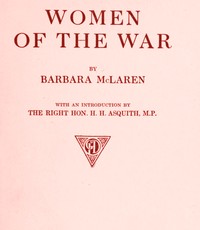
The source record for Women of the war — Context and Discussion measures this digital text at 41,689 words, 3 hr 2 min estimated reading time, and 36 detected text sections.
The text analysis averages about 24.8 words per sentence, while the detected sections provide another way to judge how the source is divided.
Project Gutenberg metadata also associates the work with “World War, 1914-1918 -- Women,” connecting these edition facts with the source record’s subject description.
Explore this collection
These alternatives are selected using recorded categories and estimated reading time.
About 186 minutes
World Events
42,554 recorded words. 4 minutes difference from this book's estimate.
View Gutenberg source #69527About 187 minutes
World Events
43,006 recorded words. 5 minutes difference from this book's estimate.
View Gutenberg source #74727About 171 minutes
World Events
39,225 recorded words. 11 minutes difference from this book's estimate.
View Gutenberg source #18650Search stored excerpts and compare books → Choose by your preferences →
Choices use stored catalog measurements. Estimates vary with reading speed. A shared category is a catalog label, not a claim that two books have the same argument or literary quality.
Search reads excerpt text stored with this catalog and links to its associated Gutenberg record. The connection is stored in the site database; this tool does not recheck that every excerpt is word-for-word identical to that external record. Excerpt search does not cover every chapter and does not verify historical publication dates.
Catalog snapshot checked: 2026-09-25. Coverage: 97 public books, 97 available source excerpts.
Read the complete public-domain text at its original source.
Read on Project GutenbergBarbara McLaren's Women of the War (1918) presents a series of profiles of women who served in World War I, from nurses under bombardment to organizers of refugee relief. The book is introduced by former Prime Minister H. H. Asquith, who praises its 'simple and unexaggerated account' and notes that it 'does not profess to be an exhaustive account' but rather selects 'some typical cases.' Asquith's framing emphasizes the voluntary, spontaneous nature of the work described, and the book's structure reflects a deliberate choice to let individual stories stand for broader patterns of service.
The excerpt detailing Violetta Thurstan's service in Russia and Belgium offers a concentrated example of the physical extremes that recur throughout the book. Thurstan is described as 'very frail' and 'always delicate,' yet she worked in a theatre-turned-hospital where 'the scenery had never been taken down after the last dramatic performance, and wounded men lay everywhere between the wings and drop-scenes.' The contrast between the theatrical setting and the reality of triage is striking. McLaren reports that during the Russian retreat from Lodz, 'over 18,000 wounded were evacuated in four days' while nurses worked 'practically without rest and under terrible conditions.' Thurstan herself was wounded and later developed pleurisy, yet returned to Russia to help organize refugee units. The text insists that her 'spirit and pluck' enabled her to endure, but it also records the toll: 'nothing that we can imagine could be worse than the reality,' Thurstan wrote of the refugees' suffering.
Asquith's introduction frames the entire volume as evidence of a new national realization: 'For the first time it has taught us as a nation to realise how large and how decisive is the part that can be played in a world-wide contest by those who are prevented from taking a place in the actual fighting line.' He stresses that 'there is no question here of any form of compulsion'—the services were 'given and suffered spontaneously by volunteers.' This emphasis on voluntarism is not merely rhetorical; it shapes how McLaren presents each woman's story. The book's method is to let the facts of service—the hours, the conditions, the numbers treated—speak for themselves. Asquith calls the narratives 'as good evidence as could be found of the depth and universality of the appeal which the war has made to our women, not only for sympathy but for service.'
McLaren's prose is generally restrained, but she allows her subjects' own words to register the enormity of what they witnessed. Thurstan's comment—'Verily the English language lacks words to express the suffering that these people underwent'—is a rare moment where the text explicitly acknowledges the inadequacy of description. The book elsewhere relies on concrete numbers: 'over five million dazed and terrified people' fled before the German advance into Russia; at one dressing station '750 patients passed through the hands of the small unit in little over twenty-four hours.' These figures accumulate to create a sense of scale that individual anecdotes alone could not convey. The tension between the need to document and the impossibility of fully capturing the experience is a quiet but persistent thread.
Readers should note that the book is organized as a series of discrete profiles, each focused on a single woman or a small group. The excerpts suggest that McLaren avoids grand conclusions, preferring to let the accumulated details of service—the long hours, the improvised hospitals, the physical risks—build a cumulative portrait. Asquith's introduction provides a useful framework for understanding the book's purpose: it is not a comprehensive history but a deliberate selection of 'typical cases' meant to illustrate the range and intensity of women's wartime work.
That rainy afternoon, I kept circling back to McLaren’s quiet note about soldiers’ exhausted hands—not the heroics, but the sheer physical weariness. It lingered, and somehow I found myself reaching for another wartime voice, one that described the same fatigue from the other side of the trench. The two books seemed to breathe together. Combed Out — Context and Discussion felt like the answer to a question I hadn’t yet formed.
Use these questions to collect your thoughts before moving on.