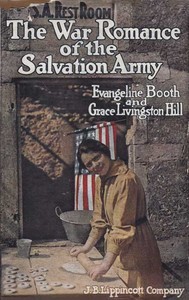
The narrative voice in The War Romance of the Salvation Army moves between two registers: the formal, almost bureaucratic tone of a commander's report and the intimate, scene-driven prose of a novelist. Evangeline Booth, as Commander-in-Chief, supplies the official framework, while Grace Livingston Hill fills in sensory details—the “flaming blossoms” laid on graves, the “awful condition” of a German-occupied house, the engine that interrupts a hymn. This dual authorship creates a text that is part institutional chronicle, part domestic vignette, and the shifts in pace between these modes are one of its most distinctive features.
From Official Dispatch to Intimate Scene
The book opens with a foreword that reads like a military memorandum: “presenting the narrative of some of the doings of the Salvation Army during the world’s great conflict for liberty.” The language is measured, collective, and purpose-driven. But within chapters, the prose contracts to close focus: a lassie gathering “great armfuls of scarlet poppies,” a captain stepping “aside onto a pile of dirt to finish his song.” These shifts are abrupt. A paragraph describing sector organization may be followed by one detailing the scrubbing of a single bedroom floor—“all day long until their shoulders ached.” The effect is a narrative that oscillates between strategic overview and bodily labor, between the war’s scale and the worker’s exhaustion.
The Weight of Physical Detail
Hill’s prose lingers on material conditions: the “filth from the bedrooms” that took two women “an entire week all but one day” to remove; the “rude cross” set up by Germans; the “pieces of his airplane shattered on the ground.” These details are not merely decorative. They anchor the narrative in the tangible, slowing the pace to match the effort described. When the text reports that a hut was “never opened since the battles of 1914,” the sentence carries the weight of years. The reader is not told about hardship in the abstract but shown the spade, the scrub brush, the flowers laid on an undecorated grave. This accumulation of concrete objects—poppies, crosses, engine noise—gives the account a documentary texture that the more sweeping passages lack.
Ritual and Interruption
Several scenes in the excerpts are structured around interrupted rituals. At Mandres, the girls decorate graves while “an air battle was going on over their heads” and an artillery train passes. The captain’s hymn is cut short by the engine. At another cemetery, a lassie lays blossoms on German graves as well as American. These moments of disruption—or of inclusive gesture—are where the narrative’s emotional weight concentrates. The prose does not comment on the irony; it simply records the engine’s approach and the singer stepping aside. The pace here is deliberate, almost ceremonial, then broken by the mundane noise of war. The effect is to make the reader feel the precariousness of the work, the way devotion and danger coexist in the same field.
Readers attentive to narrative rhythm will notice how the book’s pace mirrors the work it describes: long stretches of preparation and cleaning, punctuated by moments of sudden action or quiet ceremony. The collaboration between Booth and Hill produces a text that is neither pure memoir nor pure history but a hybrid, where the voice of command and the voice of witness share the page. Pay attention to the transitions between chapters—they often mark a shift in scale that reveals the authors’ different priorities.
When reading of the Salvation Army's quiet tenderness among the ruins, I often think of my own shelves—how another book, History of the American Negro in the Great World War, holds that same stubborn warmth in its accounts of service and grace. History of the American Negro in the Great World War His Splendid Record in the Battle Zones of Europe; Including a Resume of His Past Services to his Country in the Wars — Text and Context feels like a neighbor to that doughnut-frying devotion, both whispering of dignity in the muck.