About 481 minutes
The Irish Guards in the Great War, Volume 2 (of 2) — Text and Context
World Events
110,628 recorded words. 19 minutes difference from this book's estimate.
View Gutenberg source #72881
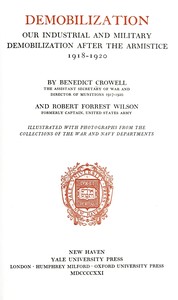
Before opening Demobilization — Edition Insights, the edition data offers a quick orientation: 114,993 words, 8 hr 20 min estimated reading time, and 30 detected text sections.
The text analysis averages about 23.6 words per sentence, while the detected sections provide another way to judge how the source is divided.
Project Gutenberg metadata also associates the work with “World War, 1914-1918 -- United States,” connecting these edition facts with the source record’s subject description.
Explore this collection
These alternatives are selected using recorded categories and estimated reading time.
About 481 minutes
World Events
110,628 recorded words. 19 minutes difference from this book's estimate.
View Gutenberg source #72881About 520 minutes
World Events
119,512 recorded words. 20 minutes difference from this book's estimate.
View Gutenberg source #76673About 479 minutes
World Events
110,067 recorded words. 21 minutes difference from this book's estimate.
View Gutenberg source #16598Search stored excerpts and compare books → Choose by your preferences →
Choices use stored catalog measurements. Estimates vary with reading speed. A shared category is a catalog label, not a claim that two books have the same argument or literary quality.
Search reads excerpt text stored with this catalog and links to its associated Gutenberg record. The connection is stored in the site database; this tool does not recheck that every excerpt is word-for-word identical to that external record. Excerpt search does not cover every chapter and does not verify historical publication dates.
Catalog snapshot checked: 2026-09-25. Coverage: 97 public books, 97 available source excerpts.
Read the complete public-domain text at its original source.
Read on Project GutenbergThe opening chapter titles—'Halt!', 'The A. E. F. Embarks', 'The Transatlantic Ferry'—signal a narrative that moves from sudden cessation to logistical complexity. Crowell and Wilson, writing as former War Department officials, adopt a voice that is at once administrative and reflective, blending statistical precision with occasional evaluative asides. The prose is dense with figures and procedural steps, yet the authors pause to remark on the 'obscure secrets of manufacture' that cannot be captured in blueprints, revealing a tension between codified knowledge and practical experience.
The excerpts show a consistent pattern: a problem is stated, a process is described in stepwise fashion, then a judgment is appended. For instance, the description of the Rochester gun plant notes that 'all the buildings are new steel and concrete structures' and that 'machinery slushed in grease and boxed' remains idle, but the authors immediately add that 'even such complete plans cannot be made to include the small kinks and short cuts of shop practice.' This three-beat rhythm—fact, detail, caveat—gives the prose a measured, almost judicial tone. The pace is deliberate, mirroring the slow unwinding of war production. When the text shifts to tabular summaries of monthly gunmaking capacity, the rhythm becomes staccato, a list of numbers that abruptly halts the narrative flow, then resumes with a broader reflection on French recuperator designs.
The collaborative authorship—Crowell as Assistant Secretary of War, Wilson as a former Army captain—produces a voice that oscillates between insider authority and detached chronicler. Phrases like 'we should never be able to build them in time' carry the weight of lived experience, while the frequent use of passive constructions ('was built,' 'is now leased') distances the speaker from the events. The narrative occasionally breaks into first-person plural ('there came to us the designs'), but quickly retreats to impersonal exposition. This instability of voice suggests a tension between the desire to document and the impulse to critique. The authors are not mere recorders; they evaluate the wisdom of decisions, as when they note that the French 'thought, with much justification, that we should never be able to build them in time.'
The text moves between two distinct paces: the inventory-like listing of facilities and capacities, and the anecdotal recounting of specific negotiations or technical challenges. The inventory passages are terse, often consisting of single sentences or bullet-like clauses: 'The Rochester plant is held entirely in ordinary'; 'The plant stands to-day as a complete gun factory.' These sections compress time, presenting a static snapshot. In contrast, the anecdotal passages expand time, as in the discussion of French recuperator plans, where the narrative slows to explain the hesitation and the eventual success. The most dramatic shift occurs when the authors insert a table of monthly production capacities, a visual and rhythmic break that forces the reader to pause and compare numbers. This alternation between the general and the particular, the static and the dynamic, structures the reader's experience of demobilization as both a bureaucratic process and a human endeavor.
Readers should attend to the way Crowell and Wilson use the physical state of plants—greased machinery, empty bays, watchmen's footsteps—as a metaphor for the larger demobilization. The book is not a dry report but a document that registers the emotional weight of sudden peace. Noticing when the authors shift from neutral description to evaluative language will reveal their implicit argument about the costs and lessons of wartime industrial mobilization.
Demobilization’s editorial notes spoke of a voice shifting from dry procedure to weary judgment, like a soldier finally exhaling. It made me think of The War and the Churches — Edition Insights, where the same quiet turn happens—from clerical certainty to something more hushed and uncertain. Both feel like archives breathing, not announcing. A shared, human faltering in the record’s tone.
Create a short personal record of your experience with this book.