About 562 minutes
The army behind the army — Key Ideas to Explore
World Events
129,054 recorded words. 5 minutes difference from this book's estimate.
View Gutenberg source #76843
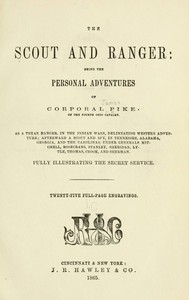
The catalog record for The Scout and Ranger Being the Personal Adventures of Corporal Pike of the Fourth Ohio cavalry — A Reader’s Guide provides practical reading context through 127,902 words, 9 hr 17 min estimated reading time, and 15 detected text sections.
The text analysis averages about 28.3 words per sentence, while the detected sections provide another way to judge how the source is divided.
Project Gutenberg metadata also associates the work with “United States -- History -- Civil War, 1861-1865 -- Personal narratives,” connecting these edition facts with the source record’s subject description.
Explore this collection
These alternatives are selected using recorded categories and estimated reading time.
About 562 minutes
World Events
129,054 recorded words. 5 minutes difference from this book's estimate.
View Gutenberg source #76843About 580 minutes
World Events
133,378 recorded words. 23 minutes difference from this book's estimate.
View Gutenberg source #71091About 589 minutes
World Events
135,309 recorded words. 32 minutes difference from this book's estimate.
View Gutenberg source #69691Search stored excerpts and compare books → Choose by your preferences →
Choices use stored catalog measurements. Estimates vary with reading speed. A shared category is a catalog label, not a claim that two books have the same argument or literary quality.
Search reads excerpt text stored with this catalog and links to its associated Gutenberg record. The connection is stored in the site database; this tool does not recheck that every excerpt is word-for-word identical to that external record. Excerpt search does not cover every chapter and does not verify historical publication dates.
Catalog snapshot checked: 2026-09-25. Coverage: 97 public books, 97 available source excerpts.
Read the complete public-domain text at its original source.
Read on Project GutenbergJames Pike's 1865 memoir opens with a preface that frames the work as a contribution to a new national literature, arguing that the private soldier's experience is as instructive as the general's. The narrative voice is direct and colloquial, often laced with dark humor. In one extended episode, Pike strolls into a Confederate-held town alone, announces he has come to demand its surrender, and is met with laughter—the townspeople mistake him for a member of Morgan's Raiders. The scene pivots on Pike's ability to control the pace: he lingers over breakfast, keeps his carbine across his knees, and lets the crowd's misperception do the work of protection.
Pike's prose moves between boastful assertion and wry understatement, often within the same paragraph. When he tells the crowd he belongs to the 4th Ohio Cavalry, he notes that “again the laugh rung out at my preposterous assertion.” The humor is self-aware: he knows how absurd his situation is. Yet the same passage contains moments of precise tension—the removal of the cap from his gun, the cocked pistol held until the weapon is returned. This alternation between swagger and restraint gives the narrative an unpredictable rhythm, keeping the reader off-balance much as Pike keeps his interrogators.
Pike often slows the narrative to render dialogue in near-transcript length, as in the extended exchange with the townspeople. The questions come in quick succession—name, regiment, colonel, captain, command location—and Pike's answers are deliberately halting: “I answered, slowly, and with a dubious look.” The effect is to stretch time, mirroring the real-time risk of each answer. When the crowd begins to whisper that he is one of Morgan's men, Pike lets the misidentification stand, and the pace quickens again as he mounts and gallops away. The dialogue thus functions as both a suspense mechanism and a character study of the scout's improvisational skill.
The physical environment in the excerpt is minimal—a hotel, a stable, a dining room, a sidewalk—but Pike uses these spaces to heighten tension. The dining room scene is particularly effective: seated beside a Confederate colonel, he slings his carbine across his knees “with the hammer up,” loosens his pistols and bowie knife, and then begins to eat. The colonel rises and flees. The setting is ordinary, but the choreography of weapons and glances turns it into a stage for a psychological duel. Pike's attention to small details—the trembling hand of the man returning his gun, the laugh that erupts at someone's expense—creates a sense of constant, low-grade peril that defines the scout's trade.
Readers should attend to the way Pike controls narrative tempo: he lingers on moments of apparent calm and races through action, inverting the usual rhythm of adventure writing. The memoir's value lies less in its battle scenes than in its quiet, nerve-wracking episodes of disguise and bluff. The preface's claim that “the simple but touching narratives of one who has survived” can illustrate the spirit of the war is borne out in these small, high-stakes encounters.
Reading Pike’s quiet terror before a duel, I remembered my grandfather’s old copy of The War Romance of the Salvation Army — Text and Context, where faith felt like the same held breath before the shot. Both books sit with fear differently — one in the saddle, one in prayer. That stillness underneath the noise stayed with me long after closing each cover.
A brief reflection can help important ideas stay with you longer.