About 381 minutes
Six months on the Italian front — Key Ideas to Explore
World Events
87,588 recorded words. 7 minutes difference from this book's estimate.
View Gutenberg source #71851
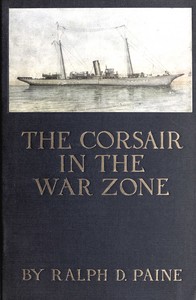
The Corsair in the war zone — Themes and Context can be approached with a clearer sense of reading commitment from its source measurements: 85,912 words, 6 hr 14 min estimated reading time, and 21 detected text sections.
The text analysis averages about 19.7 words per sentence, while the detected sections provide another way to judge how the source is divided.
Project Gutenberg metadata also associates the work with “World War, 1914-1918 -- Naval operations,” connecting these edition facts with the source record’s subject description.
Explore this collection
These alternatives are selected using recorded categories and estimated reading time.
About 381 minutes
World Events
87,588 recorded words. 7 minutes difference from this book's estimate.
View Gutenberg source #71851About 347 minutes
World Events
79,719 recorded words. 27 minutes difference from this book's estimate.
View Gutenberg source #10166About 332 minutes
World Events
76,236 recorded words. 42 minutes difference from this book's estimate.
View Gutenberg source #12877Search stored excerpts and compare books → Choose by your preferences →
Choices use stored catalog measurements. Estimates vary with reading speed. A shared category is a catalog label, not a claim that two books have the same argument or literary quality.
Search reads excerpt text stored with this catalog and links to its associated Gutenberg record. The connection is stored in the site database; this tool does not recheck that every excerpt is word-for-word identical to that external record. Excerpt search does not cover every chapter and does not verify historical publication dates.
Catalog snapshot checked: 2026-09-25. Coverage: 97 public books, 97 available source excerpts.
Read the complete public-domain text at its original source.
Read on Project GutenbergRalph D. Paine’s account of service aboard the converted yacht Corsair during the First World War is built around a striking contrast: the laconic, almost emotionless language of official naval logs versus the violent reality of storms and submarine warfare. Paine repeatedly draws attention to this gap, quoting entries that record hurricane-force winds and flooding in the same flat tone as a change of course. The book itself mirrors this tension, moving between the crew’s matter-of-fact professionalism and the extraordinary events they endure.
Paine devotes considerable space to the language of ship’s logs, which he calls “the dryest possible reading.” He reproduces entries from the hurricane that nearly sank the Corsair: “8.25 changed course N.N.E., speed 7 knots” followed by “Hurricane blowing from North. Sea very rough.” The contrast between the mundane notation and the life-threatening situation is deliberate. Paine notes that a sailor will seldom call a storm a hurricane; when he does, “you may be sure that old Boreas is giving the ship about everything he has in stock.” This observation is not merely colorful—it reveals how the book uses understatement as a narrative device. The logs become a kind of code, where the severity of an event is inversely proportional to the drama of the entry. Paine’s own prose, though more expansive, often adopts a similar restraint, letting facts speak for themselves.
The extended hurricane sequence is the book’s most sustained set piece, and Paine treats it as both a physical ordeal and a linguistic puzzle. He juxtaposes the log entries with Commander Kittinger’s slightly more explicit war diary, which “displays no signs of emotion” but does commit to calling the wind “hurricane force.” Paine then adds his own commentary, describing seas that “stove in the deck-house” and water “waist-deep in crew quarters.” The effect is a layered narrative: the official record, the commanding officer’s report, and the author’s reconstruction. This tripartite structure allows Paine to explore how different voices—the enlisted man’s log, the commander’s report, and the journalist’s account—each filter the same terrifying experience through their own conventions. The storm becomes a test not only of the ship’s seaworthiness but of the adequacy of language to convey catastrophe.
Throughout the excerpts, Paine varies the narrative pace sharply. Long passages of daily routine—coaling, drills, liberty parties—are punctuated by sudden, terse accounts of disaster. The sinking of the Antilles and the rescue of survivors are described in swift, almost telegraphic sentences, echoing the log entries. Conversely, the hurricane is drawn out over several pages, with the logs providing a rhythmic, time-stamped structure that slows the reader’s experience. Paine also includes photographs and captions that further break the text, creating a documentary feel. This alternation between the quotidian and the catastrophic mirrors the crew’s own experience: long stretches of monotony interrupted by moments of intense danger. The book’s structure thus enacts the very tension between boredom and terror that defines naval warfare.
Readers will find that The Corsair in the War Zone rewards attention to its formal choices: the embedding of official documents, the deliberate flatness of some passages, and the sudden accelerations into drama. Paine’s background as a journalist shows in his eye for telling detail and his willingness to let the logs speak for themselves. The book is best approached not as a conventional memoir but as a layered document about how men at sea record and remember extreme events.
Paine’s logbook restraint against those Atlantic gales stays with me, that quiet grip on the wheel. It made me think of the other war, the one behind the lines, where the effort was less visible but just as unflinching. I’ve carried that thought around for a while, and it led me to The army behind the army — Key Ideas to Explore. Strange, how service echoes in different keys.
A brief reflection can help important ideas stay with you longer.