1

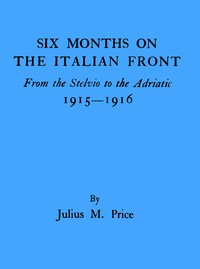
Six months on the Italian front — Key Ideas to Explore
(0 User reviews)
1693
Project Gutenberg
2023
Not confirmed
World War, 1914-1918 -- Personal narratives; World War, 1914-1918 -- Campaigns -- Italo-Austrian
Readers of public-domain and historical texts
Project Gutenberg digital edition
en
Edition facts
Words
87,588
Reading time
381 min
Text sections
50
The source record for Six months on the Italian front — Key Ideas to Explore measures this digital text at 87,588 words, 6 hr 21 min estimated reading time, and 50 detected text sections.
The text analysis averages about 31.8 words per sentence, while the detected sections provide another way to judge how the source is divided.
Project Gutenberg metadata also associates the work with “World War, 1914-1918 -- Personal narratives,” connecting these edition facts with the source record’s subject description.
Source:
Project Gutenberg record #71851
War-artist Julius M. Price recounts his six months with the Italian Army in 1915-1916, from the Stelvio to the Adriatic. His preface disclaims military expertise, framing the narrative as 'hasty impressions' gathered while covering the capture of Gorizia as the only foreign correspondent on the spot.
Read the complete public-domain text at its original source.
Read on Project GutenbergJulius M. Price, war-artist correspondent for the Illustrated London News, opens his account with a frank admission: he has 'no pretensions to pose as a Military Expert.' The book, he explains, is a collection of 'hasty impressions' from six months spent with the Italian Army, a period he recalls as 'among the happiest and best filled' of his career. This self-deprecating tone sets the stage for a narrative that prioritizes on-the-ground observation over strategic analysis.
Price's preface also reveals his unique vantage point: he was 'the only foreign correspondent on the spot' during the operations leading to the capture of Gorizia. The dedication to the Italian Military Authorities hints at the cooperation that made his access possible, while the note thanking the Illustrated London News for permission to reproduce his sketches underscores the visual dimension of his reportage.
Marching Orders and a Box of Havanas
The opening chapter, 'Marching Orders,' immediately establishes Price's method: he begins not with grand strategy but with the mundane details of travel. He describes his route from London to Rome via Folkestone and Boulogne in wartime, and itemizes his 'campaigning kit' with a wry eye. Among the essentials is 'a box of choice Havanas,' a detail that signals both his personal tastes and the relative comfort of a correspondent's life compared to a soldier's.
Price's list of kit—'the war-correspondent’s list'—includes 'quaint item' as a category, suggesting a self-aware humor about the peculiarities of his profession. This attention to the concrete, from transport delays to luggage, grounds the narrative in the physical realities of travel, contrasting with the abstract scale of the conflict he will later describe.
The Trentino Storm Breaks
In the later excerpts, Price shifts from personal anecdote to the broader military situation. He recounts the Austrian offensive of May 1916 on the Trentino Front, which he calls 'the first rumbling of the approaching storm.' His language is vivid but restrained: the '50 mile front from the Lake Garda to Val Sugana was ablaze,' and the Italian center was 'practically crumpled up by sheer weight of numbers.'
Price emphasizes the surprise of the attack, noting that 'no steps had been taken to meet it' despite the sector being recognized as a weak point. He credits General Cadorna with saving the situation by rushing reinforcements 'in motor lorries and other vehicles,' a detail that highlights the logistical improvisation of the response. The account is careful to note the rapid recovery—'within four days the Italians had recovered the whole of the lost positions'—but does not gloss over the initial crisis.
Journalistic Timing and the Gorizia Push
Price interweaves his own professional story with the military narrative. He reveals that his editor hesitated to send him back to Italy during the Austrian advance, reasoning that 'the British public were not exactly hungering after pictorial representation of Italian reverses.' Only when the Italian counter-offensive succeeded did his 'marching orders' arrive. This candid admission illuminates the pressures on war correspondents to deliver positive news.
The capture of Gorizia, which Price frames as the climax of his assignment, is introduced as the reason for his presence. He notes that he had 'the good luck to be the only foreign correspondent on the spot at these scenes of History-making,' a claim that underscores the exclusivity of his material. The narrative thus balances personal ambition with historical events, showing how journalistic access shaped what he could report.
The Author's Snapshot and Visual Evidence
A small but telling detail appears in the front matter: a photograph captioned 'The Author in San Martino del Carso. From a snapshot by Robert Vaucher.' This image, taken by a fellow correspondent, places Price physically at a specific location—San Martino del Carso, a village on the Carso plateau that saw heavy fighting. The snapshot format suggests an informal, on-the-spot record, consistent with Price's role as a visual journalist.
Price's sketches, reproduced with permission from the Illustrated London News, form a parallel visual narrative. The book's note about these illustrations indicates that the text and images were originally conceived as a package for a weekly magazine audience. Readers should consider how the written impressions complement the drawings, which Price does not describe in detail but which likely capture scenes he witnessed firsthand.
Price's narrative is best approached as a correspondent's diary rather than a comprehensive history. He warns readers that his lack of military expertise may produce 'dull pages,' but the value lies in his specific observations—the kit he carried, the delay in his assignment, the snapshot at San Martino del Carso. Pay attention to the moments when Price steps back from action to note a detail of landscape or logistics; these are the impressions he considered worth preserving.
That rain fell all afternoon, matching the gray of Price’s sketches along the Isonzo—hasty impressions, he called them, and I trusted that. His war felt unfinished, fogged with half-seen movements. Later, I wondered about the quiet ones behind it, the supply lines and field kitchens. The army behind the army — Key Ideas to Explore sat on my shelf, unplanned, and I opened it like a window into that same dim weather.
There are no reviews for this eBook.
There are no comments for this eBook.
Reader reflection
Before you leave, reflect on the book
Use these questions to collect your thoughts before moving on.
Your progress
0
/
10
2
Was reading this book enjoyable?
3
How likely are you to recommend this book?
4
How easy was the book to follow?
5
Did the book deliver what you hoped for?
6
Was the book easy to understand?
7
Which part made the strongest impression?
8
Did the book give you something worth debating?
9
In one sentence, what did you learn?
10