About 283 minutes
Under the periscope — A Closer Reading
World Events
64,970 recorded words. 0 minutes difference from this book's estimate.
View Gutenberg source #69750
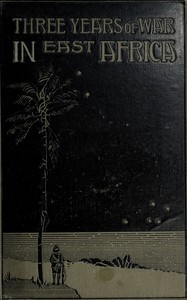
Three years of war in East Africa — A Reader’s Guide can be approached with a clearer sense of reading commitment from its source measurements: 64,929 words, 4 hr 43 min estimated reading time, and 19 detected text sections.
The text analysis averages about 24.1 words per sentence, while the detected sections provide another way to judge how the source is divided.
Project Gutenberg metadata also associates the work with “World War, 1914-1918 -- Campaigns -- Tanzania,” connecting these edition facts with the source record’s subject description.
Explore this collection
These alternatives are selected using recorded categories and estimated reading time.
About 283 minutes
World Events
64,970 recorded words. 0 minutes difference from this book's estimate.
View Gutenberg source #69750About 289 minutes
World Events
66,386 recorded words. 6 minutes difference from this book's estimate.
View Gutenberg source #15770About 269 minutes
World Events
61,807 recorded words. 14 minutes difference from this book's estimate.
View Gutenberg source #70982Search stored excerpts and compare books → Choose by your preferences →
Choices use stored catalog measurements. Estimates vary with reading speed. A shared category is a catalog label, not a claim that two books have the same argument or literary quality.
Search reads excerpt text stored with this catalog and links to its associated Gutenberg record. The connection is stored in the site database; this tool does not recheck that every excerpt is word-for-word identical to that external record. Excerpt search does not cover every chapter and does not verify historical publication dates.
Catalog snapshot checked: 2026-09-25. Coverage: 97 public books, 97 available source excerpts.
Read the complete public-domain text at its original source.
Read on Project GutenbergCaptain Angus Buchanan, a naturalist and explorer before the war, brings an unusual double lens to his account of the East Africa campaign. His prose shifts between tactical reportage and the attentive eye of a field biologist, noting the “grey-marked goat from the hills” or the “wild tomatoes” gathered to supplement short rations. This combination of soldier and scientist gives the narrative a texture rare in war memoirs.
The book follows the 25th Royal Fusiliers—a unit the foreword calls “this old Legion of Frontiersmen”—through treks, rear-guard actions, and the capture of towns like Morogoro. Buchanan’s descriptions of landscape are precise: the Ulugúru mountains are “cultivated and habited by large numbers of natives,” while the low country beyond is “a great unruffled carpet” of bush. He records not only enemy movements but also the quality of roads, the height of rivers, and the availability of food.
Buchanan’s previous work, Wild Life in Canada, signals his background as a field observer. In this war memoir, that habit of noticing persists. He remarks on “fine tropical trees, on either side of the road, tall and dark-foliaged and majestic,” and notes the undergrowth as “luxuriant and flower-lit.” These details are not decorative; they serve as navigational and logistical markers. The same man who records the enemy’s route also notes the presence of “sugar-cane stalks to chew at, a few pawpaws (Papáyu), and wild tomatoes.” The naturalist’s vocabulary—species names, habitat descriptions—sits alongside military terminology without strain.
The catalog lists “Birds — Tanzania” as a subject, and the foreword mentions Buchanan’s earlier study of “rarer flora and fauna.” Although the excerpts do not contain extended bird lists, the author’s trained eye for living things is evident in his attention to the land’s yield and its aesthetic character. He describes the Ruwu River valley as “very beautiful country,” a judgment that comes from someone accustomed to evaluating terrain for both passage and life.
Buchanan’s account is grounded in the physical realities of marching through East Africa. He measures progress in miles—130 from Morogoro to the Rufiji River—and in the quality of roads: a “good ‘made’ road, cut through the hills, and free of impossible grades” gives way to “low-lying, unhealthy bush country.” The narrative repeatedly returns to the problem of rations. At Killundi, “no rations reached us, and the battalion in their need had a much-wasted trek-ox killed, and issued as emergency ration.”
These details are not complaints but observations of fact. Buchanan’s prose is matter-of-fact: “Otherwise we had to make shift as best we could, and were hard put to it to assuage our hunger.” The reader gains a clear sense of the campaign as a contest with environment as much as with the enemy. The destruction of bridges, the depth of rivers (“not more than waist-deep”), and the availability of forage all shape the pace and possibility of advance.
Buchanan describes the German retreat as a withdrawal through “a country of bush and swamp and wilderness,” abandoning “civilised settlements and trade-centres” and the railway. The pursuit is not a linear chase but a clearing operation: “to follow the enemy, and, secondly, to clear all the country north of the Rufiji River of enemy.” The narrative structure follows the column’s movement through distinct geographical stages, each with its own character.
The author notes that the enemy used a “well-engineered road cut out of the steep hill-sides in pre-war days at the expense of gigantic labour,” a road unknown to the British command until the Germans retired along it. This detail reveals the intelligence value of terrain knowledge. Buchanan’s account treats the landscape as an active participant in the campaign—something the enemy knew and the British had to learn.
Buchanan writes in the first-person plural, as part of a collective: “we trekked,” “we encamped,” “we bade good-bye to the last of fair scene.” This voice is typical of unit histories, but here it is inflected by the author’s individual sensibility. He allows himself moments of aesthetic appreciation—“Everyone was filled with admiration for the beauties of the scenes”—without breaking the soldier’s tone.
The excerpts do not reveal the book’s full arc, including the final stages of the campaign or the fate of the 25th Royal Fusiliers. Buchanan’s foreword writer, Baron Cranworth, claims the unit participated in “the spectacular capture of Bukoba” and operations around Kilimanjaro, but the text provided begins in medias res. The reader should expect a narrative that is partial in both senses: incomplete in coverage, and shaped by one officer’s perspective.
Readers interested in the intersection of military history and natural history will find Buchanan’s account distinctive. His eye for the edible, the beautiful, and the obstructive in the East African landscape gives the campaign a concrete texture. The book is best approached as a personal record rather than a strategic overview—one that rewards attention to the small observations embedded in the larger march.
Captain Buchanan’s war diary kept returning, almost shyly, to the birds above the gunfire—a quiet insistence that life persists amid ruin. That same gentleness haunts Fragments from France — Background and Themes, where another soldier’s eye catches a wildflower’s bloom between shell holes. Years apart, yet they share a hush, a remembered softness under history’s noise.
Use these questions to collect your thoughts before moving on.