About 49 minutes
Getting Together — Reading Companion
World Events
11,070 recorded words. 15 minutes difference from this book's estimate.
View Gutenberg source #15523
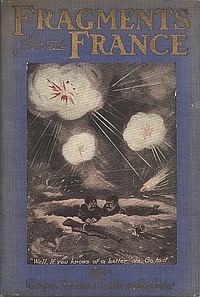
For Fragments from France — Background and Themes, the stored edition analysis reports 7,598 words, 34 min estimated reading time, and 3 detected text sections.
The text analysis averages about 15.0 words per sentence, while the detected sections provide another way to judge how the source is divided.
Project Gutenberg metadata also associates the work with “World War, 1914-1918 -- Humor, caricatures, etc.,” connecting these edition facts with the source record’s subject description.
Explore this collection
These alternatives are selected using recorded categories and estimated reading time.
About 49 minutes
World Events
11,070 recorded words. 15 minutes difference from this book's estimate.
View Gutenberg source #15523About 72 minutes
World Events
16,452 recorded words. 38 minutes difference from this book's estimate.
View Gutenberg source #13993About 76 minutes
World Events
17,431 recorded words. 42 minutes difference from this book's estimate.
View Gutenberg source #10225Search stored excerpts and compare books → Choose by your preferences →
Choices use stored catalog measurements. Estimates vary with reading speed. A shared category is a catalog label, not a claim that two books have the same argument or literary quality.
Search reads excerpt text stored with this catalog and links to its associated Gutenberg record. The connection is stored in the site database; this tool does not recheck that every excerpt is word-for-word identical to that external record. Excerpt search does not cover every chapter and does not verify historical publication dates.
Catalog snapshot checked: 2026-09-25. Coverage: 97 public books, 97 available source excerpts.
Read the complete public-domain text at its original source.
Read on Project GutenbergBruce Bairnsfather's Fragments from France collects cartoons and captions that turn the Western Front into a stage for grim absurdity. The foreword by the editor of The Bystander frames the work as a translation of the British soldier's spirit—'hating war as he hated hell'—into 'cold and permanent print.' Bairnsfather, who served at the front, does not depict heroics but instead focuses on the mundane irritations and surreal moments of trench life: a soldier annoyed at falling into a mine crater, another practicing juggling with shrapnel helmets, and the perennial gripes about rats, mud, and mouth-organs.
Several cartoons feature named or recurring figures, most notably Old Bill, who appears in 'In the Support Trench' deciding to transfer the ex-juggler Private Shinio. The captions often use generic names like Private Wm. Jones, Private Lovebird, and Private 9998 Blobs, creating a sense of everyman soldiers caught in absurd routines. The dialogue is colloquial and sardonic: 'Call me a Tank again, my lad, and I'll knock yer —— 'ead off!' and 'I wish the 'ell you'd put a cork on that blinkin' pin of yours, Bert!' These characters are not developed beyond their immediate predicaments, but their repeated presence builds a shared world of petty frustrations.
The captions catalogue a litany of minor annoyances: a soldier annoyed at friends singing 'Don't go down the mine, Daddy' after he falls into a crater; another irritated that his dug-out trouble could have been avoided if leave hadn't been postponed; and the 'Provost-Marshal Feeling' described as 'a sensation only to be had at a Base—in other words, a base sensation.' Even the natural world is weaponized: the 'Flanders Sea Lion' feeds on 'Plum and Apple Jam and Rum' and is 'only savage when the latter is knocked off.' The humor lies in the contrast between the scale of the war and the pettiness of the complaints.
Many captions rely on ironic juxtaposition. In 'Romance, 1917,' a soldier declares, 'Darling, every potato that I have is yours.' The mundane object—a potato—becomes a token of affection in a world of scarcity. 'Modern Topography' reduces a battlefield to a tourist map: 'Well, you see, here's the church and there's the post-office.' The caption for 'The Stargazers' ends with '—and their return to earth,' suggesting a fall from lofty thoughts to muddy reality. Bairnsfather also parodies official language: 'On our right there is nothing to report' appears alongside a cartoon of Captain Mills-Bomme's temperature cracking the thermometer after his battalion's daring action.
Readers should approach Fragments from France as a sequence of standalone gags rather than a narrative. The cartoons reward attention to the interplay between image and caption, often with the picture undercutting or extending the text. The foreword's claim that Bairnsfather 'has just put down what he has seen and heard and felt and smelt and—laughed at' is a useful guide: the laughter is defensive, a way of coping with the intolerable. The book is best read in short bursts, letting each fragment land its particular note of absurdity.
Reading Bairnsfather’s trenches, I remembered my grandfather’s tin of photographs, all sepia mud and hollow eyes. The grim absurdity felt familiar, but also oddly warm—like tea gone cold. The same half-smile surfaced in The First Hundred Thousand: Being the Unofficial Chronicle of a Unit of "K(1)" — Text and Context, that weary patience with the everyday nonsense of war. Both books feel less like history, more like a hand on a shoulder, saying, “Yes, exactly.”
Build a private reading journal entry for this title.