About 704 minutes
The War in the Air; Vol. 1 The Part played in the Great War by the Royal Air Force — Key Ideas to Explore
World Events
161,737 recorded words. 2683 minutes difference from this book's estimate.
View Gutenberg source #28226
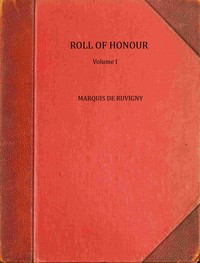
This digital edition of The Roll of Honour, Volume 1 — Context and Discussion is described by source-level measurements including 778,893 words, 56 hr 27 min estimated reading time, and 116 detected text sections.
The text analysis averages about 10.4 words per sentence, while the detected sections provide another way to judge how the source is divided.
Project Gutenberg metadata also associates the work with “Soldiers -- Great Britain -- Biography,” connecting these edition facts with the source record’s subject description.
Explore this collection
These alternatives are selected using recorded categories and estimated reading time.
About 704 minutes
World Events
161,737 recorded words. 2683 minutes difference from this book's estimate.
View Gutenberg source #28226About 594 minutes
World Events
136,480 recorded words. 2793 minutes difference from this book's estimate.
View Gutenberg source #51754About 589 minutes
World Events
135,309 recorded words. 2798 minutes difference from this book's estimate.
View Gutenberg source #69691Search stored excerpts and compare books → Choose by your preferences →
Choices use stored catalog measurements. Estimates vary with reading speed. A shared category is a catalog label, not a claim that two books have the same argument or literary quality.
Search reads excerpt text stored with this catalog and links to its associated Gutenberg record. The connection is stored in the site database; this tool does not recheck that every excerpt is word-for-word identical to that external record. Excerpt search does not cover every chapter and does not verify historical publication dates.
Catalog snapshot checked: 2026-09-25. Coverage: 97 public books, 97 available source excerpts.
Read the complete public-domain text at its original source.
Read on Project GutenbergThe preface to The Roll of Honour, Volume 1 opens with a sweeping declaration: “These men have laid down their lives for England.” The editor, the Marquis de Ruvigny, then immediately undercuts that grand tone by acknowledging that future generations will judge the war’s causes and conduct. This tension between patriotic framing and a desire for factual record runs through the entire work. The preface avoids naming specific battles or generals, instead offering a general meditation on sacrifice, while the biographical entries that follow are starkly different in style—precise, formulaic, and stripped of rhetoric.
Each entry follows a rigid template: surname, given name, rank, service number, unit, parentage, birth date and place, education, civilian occupation, enlistment details, overseas service, and manner of death. The level of detail varies: some entries include the soldier’s exact time of death (“killed in action in the German trenches at Givenchy, Flanders, 25 May, 1915”), while others simply note “lost when that ship was sunk by a mine.” The editor includes letters from commanding officers, as in the case of Private Harold Baron Hudspith, whose captain wrote that he was “extremely popular in my company.” Such quotations are rare but add a personal dimension absent from the otherwise uniform entries.
The preface employs elevated language: “the grimmest nightmare of retreat,” “laurel upon laurel,” “our children’s children will rejoice.” It speaks of men who died “with laughter on their lips” or “racked with the pain of long drawn suffering.” Yet the biographical entries contain no such flourishes. They record, for example, that Stoker Peter William Huggins was “lost in action in the North Sea, 22 Sept. 1914,” without commentary. This contrast suggests the preface was written to frame the work as a memorial, while the entries themselves serve as a bureaucratic ledger of loss. The catalog subjects list the work as a “Register of dead,” and the entries indeed function as such.
The entries cover soldiers from across the British Empire: New Zealanders like Private Maurice Huggett, who “volunteered on the outbreak of war” and died at Gallipoli; Canadians; and men from the British Isles. Social backgrounds vary widely: a draughtsman from Streatham, a stoker from Keighley, a lieutenant educated at Charterhouse. The preface mentions “boys from London Town” and men from “the fringes of the Empire,” and the entries bear this out. The work also includes naval losses, such as those from HMS Hogue, Aboukir, and Hawke, reflecting the war’s maritime dimension. The editor’s claim to record “all members” is ambitious, but the excerpts show a systematic effort to include every rank and branch.
Readers should approach this volume as a primary source for genealogical and social history rather than a narrative history of the war. The entries are best consulted individually, as the work lacks an index or thematic organization. The preface’s patriotic tone should be weighed against the entries’ factual restraint. For researchers, the volume offers a snapshot of how early-war deaths were officially recorded and commemorated, with all the omissions and biases that implies.
Day after day, I open the Marquis’s great ledger, those terse lines of lads and their trades, and a hush settles over the room. Beside me rests My Home in the Field of Honor — Inside the Classic, and somehow the two whisper to one another across the years—one an honor roll, the other a quieter hearth, both holding the same bitter sweetness.
A brief reflection can help important ideas stay with you longer.