About 196 minutes
The Emma Gees — Themes and Context
World Events
44,942 recorded words. 14 minutes difference from this book's estimate.
View Gutenberg source #20655
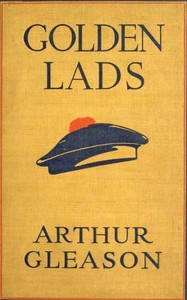
This digital edition of Golden Lads — Inside the Classic is described by source-level measurements including 48,266 words, 3 hr 30 min estimated reading time, and 6 detected text sections.
The text analysis averages about 16.3 words per sentence, while the detected sections provide another way to judge how the source is divided.
Project Gutenberg metadata also associates the work with “World War, 1914-1918 -- Personal narratives,” connecting these edition facts with the source record’s subject description.
Explore this collection
These alternatives are selected using recorded categories and estimated reading time.
About 196 minutes
World Events
44,942 recorded words. 14 minutes difference from this book's estimate.
View Gutenberg source #20655About 187 minutes
World Events
43,006 recorded words. 23 minutes difference from this book's estimate.
View Gutenberg source #74727About 186 minutes
World Events
42,554 recorded words. 24 minutes difference from this book's estimate.
View Gutenberg source #69527Search stored excerpts and compare books → Choose by your preferences →
Choices use stored catalog measurements. Estimates vary with reading speed. A shared category is a catalog label, not a claim that two books have the same argument or literary quality.
Search reads excerpt text stored with this catalog and links to its associated Gutenberg record. The connection is stored in the site database; this tool does not recheck that every excerpt is word-for-word identical to that external record. Excerpt search does not cover every chapter and does not verify historical publication dates.
Catalog snapshot checked: 2026-09-25. Coverage: 97 public books, 97 available source excerpts.
Read the complete public-domain text at its original source.
Read on Project GutenbergArthur Gleason, an American serving with the Hector Munro Ambulance Corps, opens Golden Lads with a blunt declaration: he witnessed atrocities recorded in the Bryce Report and spent months living in the war zone. The book’s dedication to the wounded sailors of the French Fusiliers Marins signals its focus on the human cost of the conflict. Gleason’s preface establishes a dual narrative: one war of aggression and machine-like brutality, another of Allied determination. He does not claim neutrality; instead, he argues that German methods have forged an unyielding will to conquer among the French, British, and Belgians.
Gleason’s role as a member of the Hector Munro Ambulance Corps placed him in direct contact with combat. He notes that the Prime Minister of Belgium placed his son in military command of the unit, allowing them to work along the first line of trenches and into villages under shell fire. The narrative moves from Ghent in September 1914 to Furnes, Dixmude, Pervyse, Nieuport, and Ypres. Gleason’s wife contributed twelve months of experience in Belgium, while his own front-line service lasted five months. This dual perspective—husband and wife both embedded—gives the account a layered intimacy, though the excerpts focus on Arthur’s observations.
Gleason offers specific, unembellished portraits of Belgian soldiers and civilians. He describes a Belgian officer who rode across an open field within rifle range to point out wounded men in a market-cart. Another figure, a sergeant with a tousled red head and three medals for valor, repeatedly exposed himself to danger. Dr. van der Ghinst remained three days in Dixmude under steady bombardment, caring for the wounded at the Hospital of St. Jean, and later walked erect past a recent shell explosion. Lieutenant Robert de Broqueville, son of the prime minister, spent three hours in Dixmude during its heaviest bombardment, picking up wounded from curbs and cellars. These vignettes avoid grand rhetoric, instead grounding heroism in specific actions.
Gleason explicitly frames the conflict as a moral struggle. He writes that German military power has sinned against women and children, and that the Allies will fight until it is overthrown. He distinguishes between two wars: one of aggression and machine-like frightfulness, and another of determined resistance. The book’s profits were designated for training maimed French soldiers, reinforcing its practical commitment to the wounded. Gleason’s language is direct and partisan, reflecting his belief that neutrality can fail to see fundamentals. He quotes King Albert’s unpublished remark that the English might yield before the Belgians, a playful assertion of Belgian steadfastness.
Readers should approach Golden Lads as a document of witness rather than a comprehensive history. Gleason’s account is shaped by his role as an ambulance driver and his moral convictions. The excerpts reveal a writer who prioritizes specific, observed moments over abstract analysis. Those interested in the texture of daily life at the front—the bugles at dawn, the shelling of Furnes, the courage of a soldier-monk—will find this narrative a valuable, if partial, record.
That rainy afternoon, the mud and courage of the ambulance drivers stayed with me long after I closed the book. Their quiet, stubborn endurance felt so personal. Later, rummaging through old shelves, I found a battered volume by Ian Hay, and its odd familiarity settled over me like a remembered scent. Somehow, the same war looked different from the trenches—less heroic, more deeply human. The First Hundred Thousand: Being the Unofficial Chronicle of a Unit of "K(1)" — Text and Context felt like a letter from the same lost world.
Build a private reading journal entry for this title.