About 147 minutes
Convict Life at the Minnesota State Prison, Stillwater, Minnesota — A Reader’s Guide
Social History
33,647 recorded words. 24 minutes difference from this book's estimate.
View Gutenberg source #48208
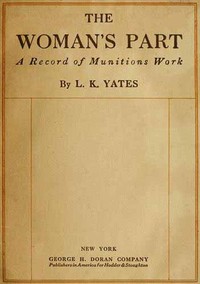
The catalog record for The Woman's Part: A Record of Munitions Work — A Closer Reading provides practical reading context through 28,208 words, 2 hr 3 min estimated reading time, and 4 detected text sections.
The text analysis averages about 27.5 words per sentence, while the detected sections provide another way to judge how the source is divided.
Project Gutenberg metadata also associates the work with “World War, 1914-1918 -- Women,” connecting these edition facts with the source record’s subject description.
Explore this collection
These alternatives are selected using recorded categories and estimated reading time.
About 147 minutes
Social History
33,647 recorded words. 24 minutes difference from this book's estimate.
View Gutenberg source #48208About 165 minutes
Social History
37,948 recorded words. 42 minutes difference from this book's estimate.
View Gutenberg source #24385About 184 minutes
Social History
42,242 recorded words. 61 minutes difference from this book's estimate.
View Gutenberg source #42507Search stored excerpts and compare books → Choose by your preferences →
Choices use stored catalog measurements. Estimates vary with reading speed. A shared category is a catalog label, not a claim that two books have the same argument or literary quality.
Search reads excerpt text stored with this catalog and links to its associated Gutenberg record. The connection is stored in the site database; this tool does not recheck that every excerpt is word-for-word identical to that external record. Excerpt search does not cover every chapter and does not verify historical publication dates.
Catalog snapshot checked: 2026-09-25. Coverage: 97 public books, 97 available source excerpts.
Read the complete public-domain text at its original source.
Read on Project GutenbergL. K. Yates's The Woman's Part opens by framing the transformation of British home industries for war as a feat of national organization, then immediately narrows to the factory floor. The book moves from the broad declaration that women's entry into engineering trades was a sudden, urgent shift to concrete scenes: women operating drawing presses for 4.5-inch cartridge cases, drilling safety-pin holes in fuses, and turning copper bands on 9.2-inch shells. Yates alternates between panoramic statements about national effort and close-up descriptions of machinery and process, a structural rhythm that persists throughout the record.
The book's chapter headings map a deliberate progression from the most iconic munitions work—shells and cartridge cases—to less expected fields. Chapter III details the manufacture of 4.5-inch cartridge cases, fuse-shop operations, and the production of cartridges and bullets. Chapter IV then moves to the making of aircraft, optical instruments, and work in shipyards. This sequence suggests that Yates intended to demonstrate the breadth of women's industrial roles, not merely their concentration in shell-filling. The text describes women operating Lumsden plain grinders to re-form 8-inch high-explosive cutters, engraving metal parts for compasses, and colouring aeroplane planes. One photograph shows a woman acting as mate to a joiner making sea-plane floats. The range of trades is presented as evidence of adaptability, with each new setting introduced by a brief technical explanation of the product before describing the workers' tasks.
Yates devotes two full chapters to comfort and safety, then outside welfare, and later a chapter on the growth of the industrial canteen. This allocation indicates that welfare was not a footnote but a central concern. The narrative traces a cause-and-effect arc: the sudden employment of thousands of women, the temporary suspension of Factory Acts, women working twelve- to fourteen-hour shifts, and the resulting crisis in housing and health. Yates then introduces the Ministry of Munitions' Welfare and Health Department, quoting Lloyd George's remark that 'the workers of to-day are the mothers of to-morrow.' The text describes welfare officers moving up and down the country, assimilating practical experiments. The inclusion of a historical precedent—David Dale's model factory in 1792—frames welfare not as a wartime invention but as an older practice given official sanction by the war's pressures.
The chapter on housing is structured around three subheadings: billeting, temporary accommodation, and permanent accommodation. Yates describes women as 'immigrants from remote corners of the Empire' who rose before dawn to travel long distances, then shared a bedroom with a night-shift worker. The text does not name specific towns but conveys a sense of strain on 'crowded industrial areas' and 'thinly populated countryside.' The discussion of billeting suggests that local families took in workers, while temporary accommodation ranged from hostels to huts. Permanent accommodation is presented as the ideal but slow to realize. The language is matter-of-fact, with phrases like 'strained to breaking-point' and 'shameful conditions' recalling the Industrial Revolution, yet the tone remains reportorial rather than indignant. Yates lets the conditions speak for themselves, then pivots to the official response.
Chapter VII, 'Growth of the Industrial Canteen,' treats the factory canteen as both a logistical necessity and a social experiment. Yates outlines general principles—the need for nutritious meals served quickly—then describes the canteen as 'the worker's oasis.' The text notes that the Health of Munitions Workers Committee investigated canteen equipment and dietary of workers, publishing memoranda 'stripped bare of officialism.' A photograph of a canteen kitchen and a view of the canteen itself appear among the illustrations, reinforcing the theme. Yates does not romanticize the food; instead, she emphasizes the practical challenges of feeding thousands of workers in shifts. The canteen is presented as a site where welfare policy met daily reality, and where the committee's scientific findings were translated into meals. The chapter closes by linking the canteen to broader morale and efficiency, but without claiming it solved all problems.
Yates's record is best read as a documentary snapshot rather than a narrative history. The book's value lies in its accumulation of specific processes—from fuse assembly to lens grinding—and its documentation of the institutional machinery of welfare. Readers interested in the material culture of wartime work will find the illustrations and technical descriptions particularly useful. The text does not attempt to assess the long-term impact of women's employment, but it preserves the language and logic of the moment when 'dilution' was a new term and the factory nursery a novel experiment.
That rainy afternoon, tucked between the canteen queues and the lathe-turning descriptions, I noticed how the women kept inventing quiet forms of solidarity. The same stubborn gentleness surfaces in the abolitionist letters of the sisters who refused to stay silent. I found myself reaching for The Grimké sisters — A Closer Reading almost without deciding to. Both books hum with that same patient, unglamorous courage.
Use these questions to collect your thoughts before moving on.