About 611 minutes
My Bondage and My Freedom — Themes and Context
Social History
140,440 recorded words. 676 minutes difference from this book's estimate.
View Gutenberg source #202
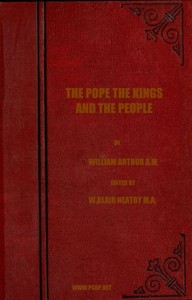
The source record for The Pope, the Kings and the People A History of the Movement to Make the Pope Governor of the World by a Universal Reconstruction of Society from the Issue of the — Inside the Classic measures this digital text at 295,874 words, 21 hr 27 min estimated reading time, and 36 detected text sections.
The text analysis averages about 24.9 words per sentence, while the detected sections provide another way to judge how the source is divided.
Project Gutenberg metadata also associates the work with “Pius IX, Pope, 1792-1878,” connecting these edition facts with the source record’s subject description.
Explore this collection
These alternatives are selected using recorded categories and estimated reading time.
About 611 minutes
Social History
140,440 recorded words. 676 minutes difference from this book's estimate.
View Gutenberg source #202About 508 minutes
Social History
116,828 recorded words. 779 minutes difference from this book's estimate.
View Gutenberg source #12422About 428 minutes
Social History
98,283 recorded words. 859 minutes difference from this book's estimate.
View Gutenberg source #12044Search stored excerpts and compare books → Choose by your preferences →
Choices use stored catalog measurements. Estimates vary with reading speed. A shared category is a catalog label, not a claim that two books have the same argument or literary quality.
Search reads excerpt text stored with this catalog and links to its associated Gutenberg record. The connection is stored in the site database; this tool does not recheck that every excerpt is word-for-word identical to that external record. Excerpt search does not cover every chapter and does not verify historical publication dates.
Catalog snapshot checked: 2026-09-25. Coverage: 97 public books, 97 available source excerpts.
Read the complete public-domain text at its original source.
Read on Project GutenbergWilliam Arthur's The Pope, the Kings and the People opens not with a thesis but with the coronation formula of the pontiffs: 'Take thou the tiara adorned with the triple crown, and know that thou art the Father of princes and of kings, and art the Governor of the world.' This epigraph immediately frames the work's central concern—the claim to universal temporal authority. The editor, W. Blair Neatby, explains in his preface that his role was limited to abridgment, preserving every word in Arthur's original order without inserting connecting phrases. The result is a text that retains the author's voice and argumentative momentum, even as it condenses a massive study of the movement to make the pope 'Governor of the World' through a universal reconstruction of society.
The book's structure is shaped by its editorial history. Neatby's preface clarifies that he performed only 'simple retrenchment,' cutting material but never adding or rephrasing. This method ensures that every sentence is Arthur's own, in Arthur's order. The abridgment runs to nearly 300,000 words across 36 text sections, suggesting the original was even more extensive. Readers encounter a work that moves from the Syllabus of Errors (1864) through the Vatican Council (1869–1870), with frequent shifts between narrative, analysis, and quoted documents. The editor's restraint means that transitions can feel abrupt, but the integrity of Arthur's argument remains intact.
Arthur repeatedly contrasts the linguistic and intellectual reach of Protestant and Catholic nations. He describes English as a 'north-western tongue, cradled amid stern winds,' which grew from a 'rude but hardy dialect' into a global language spoken by 'at least eighty millions.' German, he notes, produced a 'Titanic literature' despite political fragmentation. These passages serve as a counterpoint to the Papacy's declining influence over learning. Arthur observes that 'the two revolted tongues, German and English, with their smaller kinsmen' had filled the world with a literature unknown in the era when 'science was the echo of the Pontiff.' The image of language as a measure of power recurs throughout, tying the fate of the Papal project to broader cultural shifts.
The narrative moves fluidly between ceremonial audiences and conciliar debates. One excerpt describes a sequence of seventeen deputations presenting volumes and purses of gold to the Pope, each receiving 'a pleasant word,' culminating in the Pope's blessing: 'God grant that your example may be followed by many.' This scene of ritualized homage contrasts sharply with the General Congregation of January 4, where Bishop Martin of Paderborn defends the Draft and rebukes bishops who used language like 'to be erased.' Arthur juxtaposes these settings to highlight the tension between public deference and internal conflict. The reader is carried from the gold-filled audience chamber to the contentious council floor without explicit transition, relying on the juxtaposition to convey meaning.
Arthur's voice is learned and combative, drawing on contemporary literature from 'half Europe' (as Neatby notes). He does not feign neutrality: the Syllabus is presented as a document that 'ought to have been handled with reverence' by its critics, yet Arthur himself is clearly skeptical of ultramontane ambitions. His prose is dense with allusions—to Galileo, Bellarmine, the Thirty Years' War—and he frequently shifts from historical narrative to sweeping cultural comparison. The editor's decision to preserve Arthur's 'ipsissima verba' means that the polemical edge remains sharp. Readers should expect a work that argues as much as it narrates, with a style that can be both oratorical and precise.
Arthur's history is best approached as a contemporary document of the ultramontane controversy, not a detached scholarly account. The abridgment preserves the author's original sequence and wording, making it possible to trace his argument without editorial interpolation. Readers interested in the intersection of religious authority, nationalism, and intellectual history will find a wealth of specific detail, though they should verify quotations against the original sources. The work rewards careful attention to its structural shifts and recurring motifs.
I often think of that sober volume on the ultramontane struggle—how men argued over who would guide consciences—and then I recall the quieter testimony in My Service in the U.S. Colored Cavalry A Paper Read before the Ohio Commandery of the Loyal Legion, March 4, 1908 — Inside the Classic. Both speak of duty and devotion, though one shouts from councils and the other whispers from the saddle.
Use these questions to collect your thoughts before moving on.