About 244 minutes
Sir William Wallace — Context and Discussion
Revolutions
55,933 recorded words. 8 minutes difference from this book's estimate.
View Gutenberg source #45035
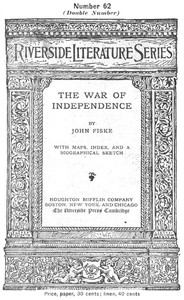
The catalog record for The War of Independence — Text and Context provides practical reading context through 54,088 words, 3 hr 56 min estimated reading time, and 7 detected text sections.
The text analysis averages about 18.5 words per sentence, while the detected sections provide another way to judge how the source is divided.
Project Gutenberg metadata also associates the work with “United States -- History -- Revolution, 1775-1783,” connecting these edition facts with the source record’s subject description.
Explore this collection
These alternatives are selected using recorded categories and estimated reading time.
About 244 minutes
Revolutions
55,933 recorded words. 8 minutes difference from this book's estimate.
View Gutenberg source #45035About 205 minutes
Revolutions
47,050 recorded words. 31 minutes difference from this book's estimate.
View Gutenberg source #11506About 201 minutes
Revolutions
46,076 recorded words. 35 minutes difference from this book's estimate.
View Gutenberg source #32966Search stored excerpts and compare books → Choose by your preferences →
Choices use stored catalog measurements. Estimates vary with reading speed. A shared category is a catalog label, not a claim that two books have the same argument or literary quality.
Search reads excerpt text stored with this catalog and links to its associated Gutenberg record. The connection is stored in the site database; this tool does not recheck that every excerpt is word-for-word identical to that external record. Excerpt search does not cover every chapter and does not verify historical publication dates.
Catalog snapshot checked: 2026-09-25. Coverage: 97 public books, 97 available source excerpts.
Read the complete public-domain text at its original source.
Read on Project GutenbergJohn Fiske opens his preface with a confession: as a boy, he wanted a book that would answer questions the old textbooks ignored—why New Jersey and the Hudson River mattered, why the British shifted focus to South Carolina, how Cornwallis ended up at Yorktown. The War of Independence (1889) is his answer, a deliberately condensed sketch that foregrounds causes and effects over picturesque detail. Fiske writes for schoolrooms and teachers, but his method—tracing strategic logic through geography and command—gives the narrative a crisp, analytical edge. The book moves from colonial background through the Stamp Act crisis, the struggle for the central Hudson corridor, the French alliance, and the war's southern phase, ending with national birth. Maps punctuate the text, and margin notes from the original edition become paragraph headers in this digital version.
Fiske explicitly distinguishes this book from the lecture series he had been delivering since 1883. Those lectures, he says, would eventually form a detailed narrative; this one is merely a sketch. The distinction matters: where a lecture might expand on personalities or local incidents, the sketch compresses events into a causal chain. Fiske aims to show why things happened, not just what happened. He cites his own boyhood frustration with textbooks that ignored such questions, and he frames the book as an experiment—one that might be followed by similar treatments of other American history periods. The preface thus establishes a pedagogical purpose: to make the war intelligible to younger readers by foregrounding strategic and political logic.
Fiske repeatedly returns to the strategic importance of New York and the Hudson River. In the excerpt on British planning, he states bluntly: 'If this could be done, the United States would be cut in two.' The British aim was to capture New York and control the Hudson, severing New England from the South. Fiske explains that because the Americans had no navy, they could not contest British command of the water; the only land communication between the regions ran across southern New York. This geographic analysis drives his account of the war's central phase. He notes that General Carleton was to come down from Lake Champlain with 12,000 men, while Schuyler could muster barely half that. The British had 25,000 troops on Staten Island; Washington had only 18,000 poorly equipped men. Fiske uses these numbers to underscore the odds, but his focus remains on the strategic problem of the center.
Fiske devotes a long paragraph to Washington's qualities as a commander, listing 'dogged tenacity of purpose, endless fertility in resource, sleepless vigilance, and unfailing courage.' He credits Washington with a 'rare geographical instinct' and mastery of concealing his plans. The passage is notable for its directness: Fiske does not merely praise Washington but enumerates specific traits—quickness in striking when the moment arrived, refusal to hazard everything on a single contest, and the ability to remain undaunted when ruin seemed near. He also notes Washington's political skills: winning confidence, discretion, tact, and a fiery temper kept under control. This portrait serves as a counterweight to the earlier depiction of British advantages, suggesting that Washington's character was the obstacle the British had not reckoned on.
The book's table of contents reveals a clear chronological and thematic arc: from the colonies in 1750, through the French wars and the first plan of union, to the Stamp Act, the crisis, the struggle for the center, the French alliance, and the birth of the nation. Each chapter builds on the previous one, tracing how political tensions escalated into military conflict and how strategic decisions shaped outcomes. Fiske's preface emphasizes that he wrote to answer causal questions—why the British government acted as it did, why certain theaters became decisive. The narrative thus avoids mere chronology; it selects events for their explanatory power. The maps—of the invasion of Canada, Washington's campaigns in New Jersey and Pennsylvania, Burgoyne's campaign, and the southern campaign—reinforce this geographical-causal approach, giving readers visual anchors for the strategic logic Fiske describes.
Fiske's sketch rewards readers who want to see the war as a series of interconnected strategic problems rather than a collection of heroic episodes. His emphasis on geography, command, and political context gives the narrative a clarity that older textbooks often lacked. Readers should note that Fiske writes from a late-nineteenth-century perspective, with assumptions about national destiny and military leadership that reflect his era. The book is best approached as a deliberately shaped argument about why the Revolution unfolded as it did, not as a comprehensive chronicle.
Fiske’s War of Independence left me thinking about how geography quietly steers big decisions—how a river or a bay can feel like fate. That same ache of inevitability lingers in The French Revolution 1789-1795 — Key Ideas to Explore, where ideas, not rivers, turn into currents nobody can stop. It stayed with me for weeks afterward.
Answer a few questions and save a private reflection on this device.