About 323 minutes
Dictatorship vs. Democracy (Terrorism and Communism): a reply to Karl Kantsky — Reading Companion
Revolutions
74,140 recorded words. 13 minutes difference from this book's estimate.
View Gutenberg source #38982
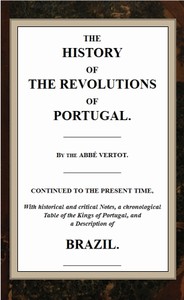
The source record for The History of the Revolutions of Portugal — A Closer Reading measures this digital text at 71,265 words, 5 hr 10 min estimated reading time, and 7 detected text sections.
The text analysis averages about 34.8 words per sentence, while the detected sections provide another way to judge how the source is divided.
Project Gutenberg metadata also associates the work with “Portugal -- History -- Revolution, 1640,” connecting these edition facts with the source record’s subject description.
Explore this collection
These alternatives are selected using recorded categories and estimated reading time.
About 323 minutes
Revolutions
74,140 recorded words. 13 minutes difference from this book's estimate.
View Gutenberg source #38982About 327 minutes
Revolutions
75,113 recorded words. 17 minutes difference from this book's estimate.
View Gutenberg source #7449About 244 minutes
Revolutions
55,933 recorded words. 66 minutes difference from this book's estimate.
View Gutenberg source #45035Search stored excerpts and compare books → Choose by your preferences →
Choices use stored catalog measurements. Estimates vary with reading speed. A shared category is a catalog label, not a claim that two books have the same argument or literary quality.
Search reads excerpt text stored with this catalog and links to its associated Gutenberg record. The connection is stored in the site database; this tool does not recheck that every excerpt is word-for-word identical to that external record. Excerpt search does not cover every chapter and does not verify historical publication dates.
Catalog snapshot checked: 2026-09-25. Coverage: 97 public books, 97 available source excerpts.
Read the complete public-domain text at its original source.
Read on Project GutenbergAbbé Vertot’s History of the Revolutions of Portugal opens not with a battle but with a challenge: the Duke of Medina Sidonia, in a letter dated September 1641, offers his town of Saint Lucar to anyone who kills John de Braganza, and proposes single combat. This theatrical gesture—complete with a twenty-day waiting period and a demand for safe conduct—reveals Vertot’s taste for dramatic, almost chivalric rhetoric. The duke’s speech is larded with formal defiance: “I hereby do offer … my town … to whomsoever shall kill the said John de Braganza.” Yet Vertot undercuts this bombast by calling it a “ridiculous comedy” and noting that the Portuguese king was “much too prudent to act a part.” The juxtaposition of grandiloquent challenge and dry authorial commentary is a recurring structural device.
Vertot’s prose oscillates between the elevated language of aristocratic honor and a cooler, analytical tone. The duke’s challenge is phrased in elaborate conditional clauses: “If he fail to obey this call upon him as a gentleman, and refuse to comply with my challenge … I hereby do offer …” This legalistic bravado is typical of the period’s honor culture, but Vertot immediately punctures it by describing the event as an “idle puppet shew.” The word “puppet” reduces the duke’s performance to a mechanical farce. Elsewhere, the narrator uses terms like “phantom” (the duke’s word for Braganza) and “traitors,” but the authorial voice remains detached, even ironic. This tension between the characters’ self-dramatization and the historian’s skepticism is a defining feature of Vertot’s style.
Vertot rarely gives direct speech, but when he does, it is carefully chosen to reveal character. The marquis d’Aïamonte is “flattered with the hope of pardon” and assured that “it depended on him alone to experience the same mercy from the best of kings.” The phrasing mimics the minister’s manipulative rhetoric: “sovereigns, like the Almighty … granted pardon to those only who sincerely repented.” This pseudo-religious language is a trap, and the marquis “signed every thing which was required of him.” Vertot does not need to editorialize; the dialogue itself exposes the duplicity. The contrast between the duke’s flamboyant challenge and the marquis’s coerced confession shows two faces of power: public bravado versus private manipulation.
Vertot builds narrative tension through selective description. The duke appears “armed cap-a-pee, and escorted by don John de Garray, colonel-commandant of the Spanish troops.” The detail “cap-a-pee” (head to foot) is archaic even for 1809, lending a mock-heroic air. Parleys are “beaten, and defiances published in the usual form”—the passive construction distances the reader, as if watching a ritual. Then, anticlimax: “no one appeared on the part of the king of Portugal.” Vertot’s description of the challenge scene is meticulous about procedure (the twenty-day limit, the safeguard for cavaliers), but he undercuts the spectacle with a single sentence of refusal. This technique—building up a set piece only to deflate it—recurs throughout the excerpts, creating a rhythm of expectation and ironic resolution.
Vertot frequently steps back from the narrative to offer judgments. He calls the duel challenge “so ridiculous a comedy” and notes that even if it were serious, “it would have been highly improper in a sovereign thus to expose his person.” These interjections are not mere asides; they shape the reader’s interpretation. The phrase “idle puppet shew” is particularly telling, implying that the duke’s theatrics are a distraction from realpolitik. The prime minister, meanwhile, “whilst amusing the people with this idle puppet shew, did not neglect turning the whole of his sovereign’s indignation on the marquis.” Vertot thus presents two parallel actions: a public spectacle and a secret judicial murder. His commentary links them causally, suggesting that the show was a deliberate smokescreen.
Readers should attend to Vertot’s habit of pairing grand gestures with deflating remarks. The challenge scene, the confession, and the execution are all framed by authorial irony that questions the sincerity of political actors. The 1809 continuation by Boisgelin de Kerdu adds a preface and notes, but the core text remains Vertot’s—a history that is as much about the rhetoric of power as about the events themselves. Approach it as a work of narrative craft, not merely a record.
A brief reflection can help important ideas stay with you longer.