About 48 minutes
Brothers in arms — Reading Notes
Modern Nations
10,903 recorded words. 5 minutes difference from this book's estimate.
View Gutenberg source #71951
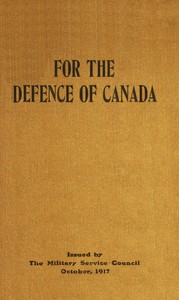
This digital edition of For the defence of Canada — Key Ideas to Explore is described by source-level measurements including 12,149 words, 53 min estimated reading time, and 3 detected text sections.
The text analysis averages about 23.8 words per sentence, while the detected sections provide another way to judge how the source is divided.
Project Gutenberg metadata also associates the work with “World War, 1914-1918 -- Canada,” connecting these edition facts with the source record’s subject description.
Explore this collection
These alternatives are selected using recorded categories and estimated reading time.
About 48 minutes
Modern Nations
10,903 recorded words. 5 minutes difference from this book's estimate.
View Gutenberg source #71951About 47 minutes
Modern Nations
10,654 recorded words. 6 minutes difference from this book's estimate.
View Gutenberg source #70744About 36 minutes
Modern Nations
8,220 recorded words. 17 minutes difference from this book's estimate.
View Gutenberg source #33139Search stored excerpts and compare books → Choose by your preferences →
Choices use stored catalog measurements. Estimates vary with reading speed. A shared category is a catalog label, not a claim that two books have the same argument or literary quality.
Search reads excerpt text stored with this catalog and links to its associated Gutenberg record. The connection is stored in the site database; this tool does not recheck that every excerpt is word-for-word identical to that external record. Excerpt search does not cover every chapter and does not verify historical publication dates.
Catalog snapshot checked: 2026-09-25. Coverage: 97 public books, 97 available source excerpts.
Read the complete public-domain text at its original source.
Read on Project GutenbergThe pamphlet opens with a sweeping defense of British entry into the Great War, asserting that neutrality was impossible given obligations to France and Belgium. The author insists the British navy was a "bulwark of freedom" and that the Empire had no aggressive designs, framing the war as a moral imperative. This rhetorical strategy establishes a tone of earnest justification that pervades the entire document.
Readers should note how the argument shifts from abstract principles of honor and obligation to concrete administrative details in later sections. The early excerpts rely on broad appeals to British identity and international law, while the middle and later excerpts focus on the machinery of the Military Service Act—tribunals, exemptions, and the role of the Military Service Council. This transition from ideology to implementation is the pamphlet's central structural feature.
The opening sections (I–III) build a case for the war's righteousness, emphasizing British reluctance and the unity of the Empire. The author claims that the United States entered the conflict "in sheer revolt against Teutonic aggression," a phrase that ties Canadian policy to a broader Allied cause. By contrast, the later excerpts (sections XXIV–XXV) are almost entirely procedural: they detail how the draft will be administered, who may claim exemption, and how appeals will be handled. The shift is abrupt and complete. A first-time reader should watch for this pivot around the middle of the text, where the language of high principle gives way to the language of regulation. The pamphlet does not reconcile these two modes; it simply moves from one to the other, suggesting that the authors considered the moral case already settled and the practical details the real substance of the document.
A striking feature of the later excerpts is the emphasis on procedural safeguards. The Military Service Council is described as bipartisan, with members chosen "equally from the two great political parties." Local tribunals exercise "perfect independence" in individual cases, and an ultimate appeal lies with Mr. Justice Duff of the Supreme Court. The pamphlet is at pains to show that the draft will be administered with "just and equal regard to the interests of all classes." This language of fairness is central to the pamphlet's persuasive purpose: it aims to reassure Canadians that conscription will not be arbitrary or partisan. The detailed description of exemption categories—religious scruples, essential occupations, domestic hardship—serves the same end. Readers should note that the pamphlet does not mention any opposition to conscription; it presents the system as a rational, equitable solution to a national need.
Section XXIV contains a revealing passage on agricultural exemptions. The pamphlet argues that farm labor must not be "substantially diminished" because food production is vital to Canada, the armies, and the allied countries. It also links exports to national revenue and Canada's ability to provide credits to Britain: "Britain’s purchases in Canada will be measured by the amount of credit that Canada can supply." This economic reasoning is a key part of the pamphlet's argument for a selective draft. The author claims the draft will operate with "greater equality" than voluntary recruiting, citing the example of farms where the only son has enlisted while others stayed home. This appeal to fairness—correcting the inequalities of voluntary service—is a recurring theme. Readers should observe how the pamphlet balances military necessity with economic stability, presenting conscription not as a drain on the home front but as a managed system that prioritizes essential work.
The pamphlet's voice is official and authoritative, but it also seeks to persuade. The opening sections use inclusive language: "By British people one means not only those of English speech and British origin, but all of any race or tongue or creed who salute the flag." This expansive definition of Britishness is clearly aimed at a diverse Canadian audience, including French Canadians and recent immigrants. The later sections adopt a more bureaucratic tone, but they still address the reader as a citizen who needs to understand how the law will affect him. The pamphlet never directly addresses potential draftees as "you"; instead, it speaks in the third person about "the men" and "the individual." This distancing may reflect the pamphlet's dual purpose: to inform and to reassure, but also to assert the state's authority. A first-time reader should consider who the intended audience might be—not just young men of military age, but their families, employers, and the broader public whose support was needed for the policy to succeed.
This pamphlet is best read as a primary source on Canadian wartime propaganda and policy. Its value lies not in literary merit but in the way it reveals the arguments and administrative structures used to justify conscription. Pay attention to what is omitted: there is no mention of anti-conscription sentiment, no discussion of casualties, and no acknowledgment of the moral complexity of forcing men to fight. The pamphlet presents a world where the war is just, the draft is fair, and the only question is how to implement it efficiently. That perspective, carefully constructed and relentlessly optimistic, is itself the most telling evidence of the government's approach to public opinion in 1917.
That pamphlet about Canada’s conscription debate stayed with me—not for its politics, but for how ordinary people were asked to hold impossible weights. It made me think of another old book, Incidents of the War: Humorous, Pathetic, and Descriptive — Context and Discussion, where the same war shows its smaller, human edges. Reading them together felt like seeing the same storm from two different windows, neither one quite letting you forget the other.
Create a short personal record of your experience with this book.