About 47 minutes
The revolt in Arabia — A Reader’s Guide
Modern Nations
10,654 recorded words. 1 minutes difference from this book's estimate.
View Gutenberg source #70744
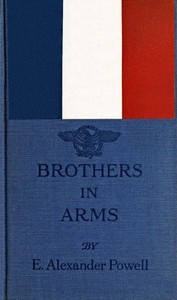
Brothers in arms — Reading Notes can be approached with a clearer sense of reading commitment from its source measurements: 10,903 words, 48 min estimated reading time, and 4 detected text sections.
The text analysis averages about 27.9 words per sentence, while the detected sections provide another way to judge how the source is divided.
Project Gutenberg metadata also associates the work with “World War, 1914-1918 -- United States,” connecting these edition facts with the source record’s subject description.
Explore this collection
These alternatives are selected using recorded categories and estimated reading time.
About 47 minutes
Modern Nations
10,654 recorded words. 1 minutes difference from this book's estimate.
View Gutenberg source #70744About 53 minutes
Modern Nations
12,149 recorded words. 5 minutes difference from this book's estimate.
View Gutenberg source #74336About 36 minutes
Modern Nations
8,220 recorded words. 12 minutes difference from this book's estimate.
View Gutenberg source #33139Search stored excerpts and compare books → Choose by your preferences →
Choices use stored catalog measurements. Estimates vary with reading speed. A shared category is a catalog label, not a claim that two books have the same argument or literary quality.
Search reads excerpt text stored with this catalog and links to its associated Gutenberg record. The connection is stored in the site database; this tool does not recheck that every excerpt is word-for-word identical to that external record. Excerpt search does not cover every chapter and does not verify historical publication dates.
Catalog snapshot checked: 2026-09-25. Coverage: 97 public books, 97 available source excerpts.
Read the complete public-domain text at its original source.
Read on Project GutenbergE. Alexander Powell opens Brothers in Arms with a direct appeal to American readers, framing the arrival of a French mission in 1917 as a historic turning point. He writes from personal experience: “because I have myself marched with the armies of France” and witnessed the wounded, the white crosses, and the destruction of churches and cities. The book is not a detached report but a persuasive argument for urgent American action.
Powell grounds his authority in direct observation. He states he has “marched with the armies of France” and seen “the endless rows of white-bandaged wounded” and “the other rows of white crosses” on hillsides. These details are not merely descriptive; they serve to authenticate his call to readers. He also notes the “desecration of her churches and the destruction of her cities” and “cruelties inflicted on her civil population by a brutal and ruthless soldiery.” The language is deliberately visceral, aiming to stir sympathy and resolve. Powell’s role is that of a witness who translates battlefield reality into a moral imperative for his countrymen.
A central argument is that Americans “utterly fail to realize the seriousness of our situation.” Powell counters the prevailing optimism that the war would end quickly with an Allied victory. He insists that Germany is a “ferocious, formidable, and desperate adversary” with “spikes on her boots and brass knuckles on her fingers.” He warns that “the mere appearance of American troops upon the battle-line is not going to end the war.” Instead, he calls for “intelligent coördination of effort” and “the exertion of every ounce of our strength.” The tone is urgent, even grim, as he tries to puncture what he sees as dangerous illusions.
Powell portrays France as near collapse: “rapidly approaching complete military and economic exhaustion” and “faint and gasping.” He claims that “had we remained aloof, the war would in all probability have ended before this year was over, but not in a victory for the Allies.” The “almost pathetic eagerness” of Allied governments for American aid is presented as proof of their desperation. He also warns that Germany’s submarine campaign is “an almost unqualified success,” threatening England with starvation. The book thus frames American intervention not as a choice but as a necessity to prevent a German victory that would endanger global freedom.
Powell’s text is a period piece that reveals how the war was presented to the American public in 1917. Readers should note that the excerpts do not include later sections that might discuss the actual arrival of American forces or the war’s end. The book’s value lies in its snapshot of wartime rhetoric and the specific arguments used to mobilize a nation.
Powell’s plea for exhausted France lingers like an old photograph, the weight of its urgency still pressing softly against my thoughts. It made me recall, unexpectedly, the quiet authority in History of the Catholic Church from the Renaissance to the French Revolution — Volume 1 — Reading Companion, where another kind of endurance—institutional, spiritual—unfolds across centuries, not battlefields. Strange, how different forms of patience echo one another.
A brief reflection can help important ideas stay with you longer.