About 271 minutes
From Fort Henry to Corinth — Key Ideas to Explore
Modern Nations
62,132 recorded words. 0 minutes difference from this book's estimate.
View Gutenberg source #24438
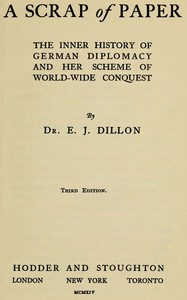
This digital edition of A scrap of paper — Background and Themes is described by source-level measurements including 62,222 words, 4 hr 31 min estimated reading time, and 18 detected text sections.
The text analysis averages about 25.4 words per sentence, while the detected sections provide another way to judge how the source is divided.
Project Gutenberg metadata also associates the work with “World War, 1914-1918,” connecting these edition facts with the source record’s subject description.
Explore this collection
These alternatives are selected using recorded categories and estimated reading time.
About 271 minutes
Modern Nations
62,132 recorded words. 0 minutes difference from this book's estimate.
View Gutenberg source #24438About 277 minutes
Modern Nations
63,516 recorded words. 6 minutes difference from this book's estimate.
View Gutenberg source #75931About 283 minutes
Modern Nations
65,004 recorded words. 12 minutes difference from this book's estimate.
View Gutenberg source #18292Search stored excerpts and compare books → Choose by your preferences →
Choices use stored catalog measurements. Estimates vary with reading speed. A shared category is a catalog label, not a claim that two books have the same argument or literary quality.
Search reads excerpt text stored with this catalog and links to its associated Gutenberg record. The connection is stored in the site database; this tool does not recheck that every excerpt is word-for-word identical to that external record. Excerpt search does not cover every chapter and does not verify historical publication dates.
Catalog snapshot checked: 2026-09-25. Coverage: 97 public books, 97 available source excerpts.
Read the complete public-domain text at its original source.
Read on Project GutenbergThe book opens with the German Chancellor’s dismissal of the Belgian neutrality treaty as “a scrap of paper,” a phrase Dillon calls “a Satanic sneer.” He argues this reveals a Prussian doctrine replacing social trust with militaristic force. The introductory chapter sets a polemical tone, framing the work as an exposé of German ambitions.
Dillon seizes on the “scrap of paper” remark as both title and thesis. In the introductory pages, he dissects the phrase’s implications, claiming it undermines “the inner cohesive force which holds the elements of society together.” This rhetorical strategy recurs: the phrase is not merely quoted but analyzed as a symptom of a broader worldview. The author contrasts the German Chancellor’s casual dismissal with British indignation, setting up a moral dichotomy that structures the narrative. Readers should note how Dillon returns to this image in later chapters, particularly Chapter XI, titled “Just for ‘A Scrap of Paper’.” The phrase becomes a lens through which he interprets diplomatic exchanges, suggesting that the treaty’s perceived worthlessness in Berlin justified aggressive expansion.
Dillon reconstructs conversations between European powers, often using direct quotation to dramatize positions. For instance, he reports Germany’s plea: “It was not we who sent the ultimatum. Neither did we know the text of it.” Yet he immediately undercuts this by noting Germany’s refusal to restrain Austria. This technique—presenting a claim then countering it with action—appears throughout. The author attributes motives explicitly: Austria “was bent on getting something more than satisfaction,” while Russia, via Foreign Minister Sazonoff, is shown making concessions. Dillon’s narrative voice is judgmental, labeling German responses “wantonly insolent in form.” Readers should track how he assigns responsibility, often contrasting Russian conciliation with German intransigence.
Dillon treats military preparations as communicative acts. He notes Russia’s modification of conscription laws to “facilitate mobilization should that measure be subsequently resorted to,” and later clarifies that mobilization was “a mere intimation that Russia must be consulted.” This interpretation—mobilization as negotiation rather than war—is central to his argument that Germany and Austria misread Russian signals. The author contrasts this with the German Kaiser’s earlier declaration that “nothing must be settled without the intervention of Germany.” By juxtaposing these statements, Dillon suggests a clash of diplomatic languages: Russia’s measured steps versus Germany’s demand for dominance. The excerpts do not reveal the outcome of these maneuvers, but the framing implies that miscommunication fueled escalation.
Chapter VI, “The Position of Italy,” and Chapter VII, “The Twelfth Hour,” indicate Dillon’s attention to secondary players and timing. Though the excerpts do not include these chapters, their titles suggest a focus on Italy’s stance and last-minute diplomacy. The table of contents shows a progression from laying out Germany’s scheme to examining specific crises. Readers approaching the book should expect a chronological structure that widens from German planning to European reactions. The “Twelfth Hour” chapter likely details the final days before war, a period Dillon describes earlier as one where Russia “went beyond the Hercules’ pillars of conciliation.” The inclusion of Italy hints at alliance dynamics that complicate the central narrative of German aggression.
Dillon’s account is best read as a contemporary polemic, not a neutral history. His use of quoted diplomatic exchanges and his focus on the “scrap of paper” phrase provide a specific entry point into pre-war tensions. Readers should weigh his attributions of motive against other sources, as the excerpts show a clear partisan stance. The book’s value lies in its immediacy and its detailed reconstruction of diplomatic language.
That rainy afternoon, the grey light made the old analysis of the 'scrap of paper' feel almost unbearably current, how promises dissolve into pragmatics. Afterwards, I found myself reaching for something gentler, and landed on Brothers in arms — Reading Notes. Its quiet edges of loyalty made the diplomatic ruin feel less like a lesson and more like a loss.
Capture what you thought, learned, and would like to remember.