
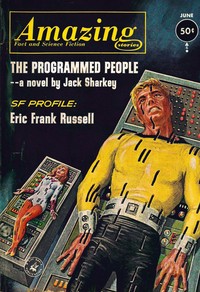
The programmed people by Jack Sharkey
I picked up Jack Sharkey's 'The Programmed People' expecting a fun, pulpy sci-fi adventure from 1962. What I got was a surprisingly thoughtful story that sticks with you. It's not about epic space wars or alien invasions. Instead, it's a quiet, unsettling puzzle.
The Story
The plot is straightforward. A survey ship from Earth lands on the planet Myrna. The crew finds a society that seems perfect. The cities are clean, the people are healthy and perpetually polite. There's no crime, no poverty, no arguments. The main character, Conn, is the first to feel that something is deeply wrong. He tries to have a real conversation, but gets only scripted, cheerful responses. He tries to break a simple rule, and the entire society smoothly works to correct him without a hint of anger. The mystery isn't a 'whodunit,' but a 'what-is-this?' The tension builds as Conn digs deeper, trying to find the source of the programming and whether there's a real person left inside any of the smiling citizens.
Why You Should Read It
What I loved most was how this book makes you think. Sharkey isn't just writing about robots. He's asking big questions about freedom, happiness, and comfort. Is a safe, easy, pre-ordained life better than a messy, free, and difficult one? The 'programmed' people aren't suffering; they seem genuinely content. That's what makes the hero's mission so complicated. The book also has a great, paranoid atmosphere. Every friendly smile starts to feel like a threat. It’s a product of its Cold War era, but the fear of losing your individuality to a system feels fresh today.
Final Verdict
This is a perfect book for fans of classic 'Twilight Zone'-style sci-fi, where the big idea is the star. It's for readers who enjoy stories like 'Stepford Wives' or episodes of 'Black Mirror' that explore social control. It's a short, fast read—you could finish it in an afternoon—but it leaves a long shadow. Don't go in expecting hard science or complex characters. Go in for a clever, creepy concept that will have you side-eyeing anyone who seems a little too pleasant and predictable. A forgotten little thought-bomb from the early 60s that still packs a punch.
No rights are reserved for this publication. Feel free to use it for personal or commercial purposes.
Melissa Johnson
2 years agoHonestly, it challenges the reader's perspective in an intellectual way. One of the best books I've read this year.


John Sanchez
10 months agoGreat digital experience compared to other versions.